
The B2B Demand Generation Lesson Behind the $40M Pipeline
People remember that $40 million number. It’s the number that appears in conversations, presentations, and headlines. But it isn’t the number I remember.
The one that stuck with me was much earlier, in a year where we were doing pretty much everything the conventional B2B marketing says you should. Campaigns were on schedule. We were on MQL targets. Channel performance was looking good. Everything on paper indicated our success.
But all those pipeline reviews were followed by the same awkward conversation. Sales couldn’t confidently attribute all that marketing activity to a qualified pipeline. We had lots of reports on what marketing had done, but little confidence in what it had actually contributed to the business.

Looking back, this became one of my biggest B2B demand generation lessons. We had no problem with execution. We had a thinking problem. The problem was the question we were asking. We were looking for better campaigns, better channels, better tactics.
The real lesson behind the $40 million in qualified pipeline was not about generating more leads. It was the realization that successful B2B pipeline building starts when you stop asking “How many leads can we generate?” and start asking “What qualified pipeline are we actually trying to build?” And then everything changed.
The B2B Demand Generation Lesson We Learned Too Late
In retrospect, I don’t think we had a marketing problem. We had a measurement problem.”
Marketing was tasked with generating leads. Sales was responsible for building pipeline. Between those two numbers was a gap that nobody really owned. Marketing celebrated activity every quarter, sales defended pipeline, and leadership struggled to reconcile two stories that didn’t quite fit.
Mistake #1: Using MQLs as our primary definition of success. An MQL is a useful signal, but it is still a proxy. And every team, without even realizing it, optimizes for the metrics they are measured by. We got better at generating MQLs, as that was what success looked like. Whether those leads converted to a qualified pipeline was often another discussion.
The second error was in the planning. Quarters were the center of everything. Quarterly plans were quarterly thinking. It felt like every new quarter we were back to square one. Campaigns finished, reports filed, and we moved on to the next project. Nothing was built to compound over time.
The third mistake was less obvious, but probably the most important one. We didn’t have a great pipeline thesis. Everyone had a different view of which accounts mattered and why. Our ABM program became a tactic for a target list, rather than a business decision based on a shared view of where we should get qualified pipeline.
This didn’t happen due to lack of capability on the team. The campaigns were very well run. The channels were to his liking. There was real effort. One of the biggest B2B demand generation lessons I learned is that the execution can look impressive while the system quietly rewards the wrong outcome. It wasn’t in the way we marketed. It was in our definition of success.
The B2B Pipeline Building Shift That Changed Everything
Nothing changed until we changed what marketing was responsible for.
That was the call.
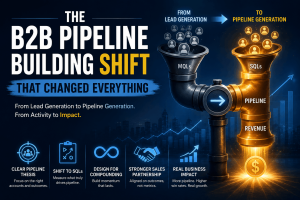
This was not about a new campaign, a different channel, or yet another marketing tool. We decided that marketing would no longer bring lead reports to quarterly business reviews. Instead we would do pipeline reviews (qualified pipeline contributed, pipeline velocity, and our influence on win rates). “If we couldn’t tie our work to those outcomes, we had to ask ourselves if the work was worth doing.”
That sounds like a minor change in reporting. It wasn’t. The whole team’s focus got affected.
We stopped optimizing for MQLs
The first major operational change was shifting the primary marketing metric from MQLs to SQLs. That one decision changed the way we measured campaigns, content, and channels immediately. We stopped asking if a campaign generated more leads and started asking if it generated conversations that had a reasonable opportunity to become pipeline.
We Built a Pipeline Thesis Before Running Campaigns
Our ABM program also changed. We’ve always thought of ABM as a campaign on a target account list. Now it became a business decision based on a pipeline theory. We identified the accounts that really mattered, understood why they mattered, and connected all activity to a defined pipeline contribution instead of simply trying to increase engagement for the sake of engagement.
We Designed for Compounding, Not Quarters
Plans changed just as dramatically. We continued to run campaigns every quarter, but we stopped thinking in quarters. So instead we created an 18-month demand gen system, each campaign building on the last. The goal was not to get momentum going again every quarter but to create momentum that would build over time.
Probably the biggest change was our relationship with sales. Marketing stopped being a lead supplier and started being a pipeline partner. We were having more honest conversations because we were looking at the same outcomes, not defending different metrics.
There had been resistance, a lot of it. The first pipeline review was awkward. Campaigns that had seemed successful based on MQL volume suddenly didn’t look so good when you measured them against qualified pipeline. It was a tough conversation, but one that forced us to face the truth. Looking back, that discomfort was not a setback. This was the day that fundamentally changed our approach to B2B pipeline building.
What These B2B Demand Generation Lessons Actually Proved
The results didn’t convince me we’d found a better marketing strategy. They told me that at last we had started to track the right outcomes.
The first sign was a 350% increase in inbound SQLs. That wasn’t because we launched more campaigns or expanded into new channels. This occurred because every campaign was designed to drive sales-qualified opportunities instead of simply driving MQL volume. Once the team had been measured on SQLs, it was natural to want to create more of them.
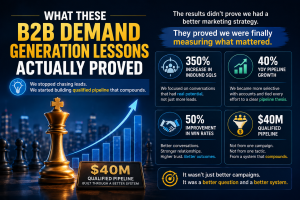
Next, through our ABM program, we saw 40% year-over-year pipeline growth. We didn’t do it by chasing more accounts. In fact, we became more choosy. The difference was that each account was selected for a reason that tied back to a clear pipeline thesis and defined business outcome, not because it met a list of firmographic filters.
A 50% improvement in win rates is the outcome I value the most. That number was the reminder that demand generation doesn’t stop when a lead goes to sales. Buyers who have been intentionally demand-generated have a different sales conversation because you’ve built trust and understanding. Sales doesn’t have to build belief from zero it builds on belief that exists already.
That approach eventually built up to a $40 million in qualified pipeline. We did not find one quarter or one breakthrough tactic. The first year was small. The second year told us we were on the right track. By the third year, the figures were impressive to outsiders. Inside the business they could see the predictable outcome of a system that had been given enough time to compound.
That was one of the biggest B2B demand generation lessons I’ve taken forward. The channels didn’t change much. The campaigns were not all that different. What changed was the question we asked, and everything we built after that was optimized to answer it.
The One B2B Demand Generation Lesson That Stayed With Me
Looking back, I don’t think the biggest change was our reporting, or our ABM program, or even the way we planned campaigns.
That was what we wondered.
The systems an organization builds reflect the questions it asks. If the question is “how many leads can we generate this quarter?” you’ll build a lead generation system. You’ll optimize for activity, celebrate volume, and reset every couple months.
But if the question shifts to “What qualified pipeline can we build, and how do we build it so that it compounds?” then everything starts to shift. Marketing, sales, measurement, planning, and even the conversations inside the business start to move in the same direction. Channels may remain the same. The campaigns may sound familiar. But the results are fundamentally different because the system that produced them has changed.
To me, this is the most valuable of all B2B demand generation lessons I have learned. The breakthrough was not better campaigns. The better question was what the system was designed to produce.
To understand the full thinking behind this approach, the three components of a demand generation engine, why they matter, and how they work together, I explain the full framework in B2B Demand Generation: How Pipeline Is Really Built. This post is the evidence. The pillar page is the philosophy of it.