Most founders approach the Fractional CMO conversation with the wrong frame. They think they are looking for a part-time CMO that they can afford.
No, they are not.
They’re looking for a specific kind of senior marketing leadership that only makes sense at a specific stage. It is knowing that distinction that is what makes or breaks the engagement.
A Fractional CMO for B2B is not a part-time CMO, a lower-cost alternative to an executive hire, or an experienced marketer filling in until the company can afford someone permanent. The model is different at the structure level.
It’s not the same time commitment. The range is different. The CMO’s relationship with the founder, team, agencies and sales organization is different. But the reason for bringing that person in is different. Most importantly.
That distinction is important because the wrong expectation can ruin a good engagement.
Eventually there will be a mismatch if a founder hires a Fractional CMO because they want the responsibilities of a full-time CMO without making the investment of a full-time role. The company might expect daily involvement, constant availability, direct ownership of every marketing activity, and immediate execution across every channel.
That’s not what the model is meant to give.
The question is not, “How can I get a CMO without hiring one full-time?”
The better question is “What level of senior marketing leadership does the business really need right now?”
That is a different question.
Some companies will answer with a Fractional CMO. The company might have people capable of running campaigns, but no senior person connecting positioning, demand generation, sales alignment, measurement, and budget decisions into one coherent marketing direction.
For others, the answer is a full-time CMO. Trying to shoehorn a fractional model in when the marketing organization has grown to the point where it needs daily executive leadership, the scope requires ongoing internal engagement, or the business needs a senior marketing leader embedded in the organization on a daily basis can create more constraints than it solves.
And there are companies where neither is the answer right away.
Sometimes the problem is not the lack of a CMO. Sometimes the company lacks the foundations for senior marketing leadership to function effectively. Sometimes the founder is looking for someone to make up for unclear positioning, weak sales discipline, poor execution capacity or unrealistic expectations about how quickly marketing can produce revenue.
Those realities won’t go away by simply adding a Fractional CMO to the company.
That’s why the better question is not if the model is “better” or “cheaper” in the abstract, but when to hire a fractional CMO.
The model works when the company’s stage, needs and internal capability align with what fractional leadership can actually deliver.
It also works best when the CMO has something meaningful to own.
That ownership matters. Senior marketing leadership is more than just creating a strategy document, attending a weekly meeting, or reading campaign reports. The value is in decision-making. Decision-making around what the company should focus on, what it should stop doing, where the resources should go, how marketing should work with sales, what the team should measure, and what problems need to be solved first.
That is also why the difference between fractional CMO vs full-time CMO cannot be reduced to a comparison of hours or salary.
The two models might have similar responsibilities, but the context of operation is different. And every working day there’s a full-time CMO in the leadership structure of the company. A Fractional CMO provides senior-level thinking and accountability applied to the business within a defined scope and cadence.
Neither one is the right answer by default.
The question is whether the model is appropriate to the problem.
That’s the lens I use when founders ask me about fractional leadership. I don’t think the goal should be to convince a company they need a Fractional CMO. “The objective should be to understand whether it really needs one and whether the company is ready to use that leadership effectively.
This is the honest guide, and I wish I had when founders first started asking me about this model. That includes the parts that don’t always favor getting one.
What a Fractional CMO Actually Does
In a company’s marketing hierarchy, a fractional CMO for B2B fills a specific role: senior strategic leadership without a full-time commitment. The exact scope varies from company to company, but there are some responsibilities that should almost always fall to this role and some that shouldn’t.
What a Fractional CMO IS doing
-
Diagnosing first:
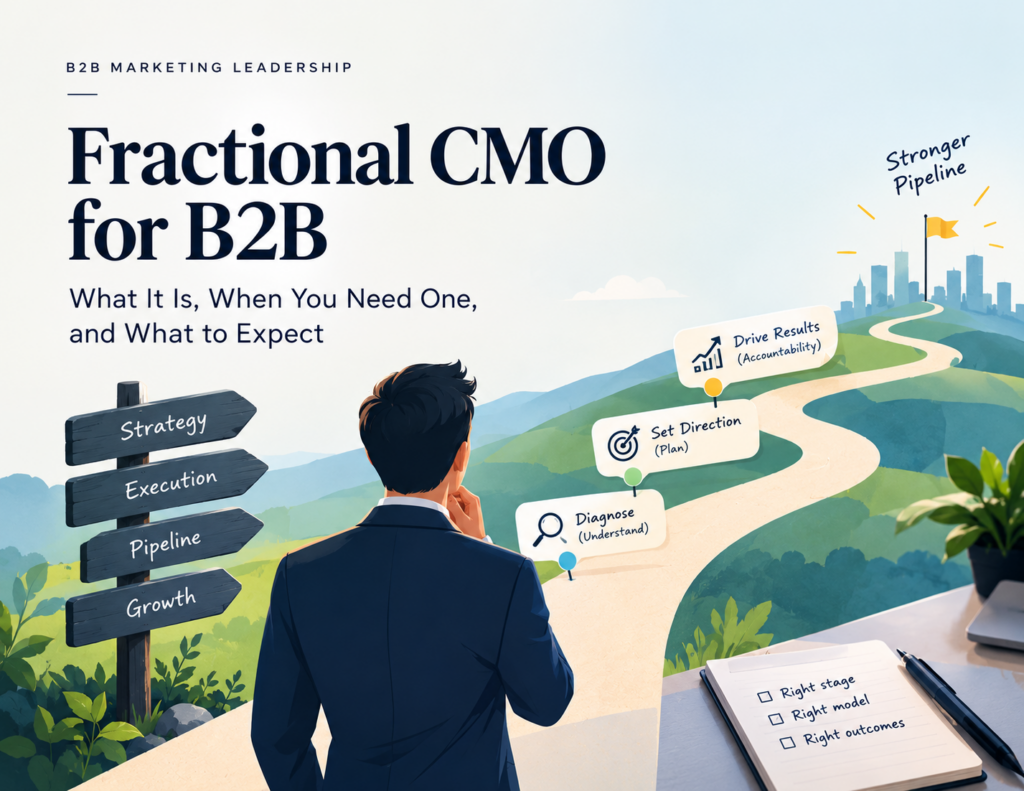
The first 30-60 days should be diagnostic. Before changing campaigns or adding channels, the CMO needs to know where marketing is, the pipeline, positioning, team, channels and measurement. Where is there commercial outcome from marketing activity, and where is there just activity without enough pipeline behind it? Anyone who builds before answering those questions is gambling.
-
Setting the strategic direction:
Once the diagnosis is made, the job is to figure out where marketing fits in. This means deciding which markets to serve, what position you will own, which channels are worth investing in and what the demand generation engine should look like. This is strategic work requiring senior judgment, not just another execution resource.
-
Owning the accountability:
A Fractional CMO is not a consultant who comes in, drops a strategy document on the table, and leaves. They need to be in the revenue conversation and accountable for the commercial direction of marketing, including qualified pipeline. “We should be looking at whether the system is producing the right outcomes and not whether the team completed a list of activities.
What a Fractional CMO is NOT doing
-
Executing day-to-day:
A Fractional CMO isn’t the person who writes every article, manages every paid campaign, or builds every landing page. If there is no execution capacity, the CMO should build, hire or manage the team responsible for it. They are not the execution team, their role is to lead the function.
-
Solving a sales problem:
Marketing can generate demand and create the conditions that allow sales to succeed. It cannot close deals, fix pricing, or fix a broken sales process. But if the real problem is on the sales side, adding marketing activity won’t fix it.
-
Working miracles in 90 days:
A credible marketing system takes time to compound. A Fractional CMO can speed up diagnosis, prioritization, and implementation but cannot reduce the underlying time it takes for demand generation to mature. Systems that produce a compounding pipeline can take 12–18 months to see their full effect. But expecting a full transformation in one quarter is setting the wrong definition of success from the start.
This is also why when to hire a fractional CMO is less about wanting “more marketing” and more about whether the business actually needs senior marketing leadership with something meaningful to own.
When You Need One and When You Don’t
Now it’s less about whether a Fractional CMO for B2B sounds useful and more about whether your company has the conditions for the model to work.
Fractional leadership makes sense at a fairly specific point. There are also cases where it doesn’t. Both of those.

When a Fractional CMO Makes Sense
-
You have a proven product, but pipeline is not repeatable.
They know there is a market for what they sell, but marketing is not consistently producing qualified opportunities. You may have campaigns, content, agencies or a marketing team, but there is no reliable system to connect those activities to the pipeline.
-
The founder has reached the ceiling of founder-led marketing.
Early-stage founders often lead marketing themselves because no one understands the product, customer or market as well as they do. That can work for a bit. But the bottleneck eventually becomes the founder. Marketing needs dedicated senior direction, and the founder needs to spend time elsewhere in the business.
-
You have execution but no strategic direction.
Perhaps you’ve worked with agencies or hired junior marketers. We’re making progress, but the pieces don’t fit. Content, paid media, events, SEO, and sales activity may all have an owner, but no one is deciding what the overall marketing system should accomplish. That is a gap of strategy, not necessarily of execution.
You are a Series A-C company that needs senior leadership before a full-time CMO makes sense.
The business may require CMO-level thinking and accountability but not necessarily a senior executive in the organization on a daily basis. This is one of the cases where the fractional model is able to be fitted.
The board or investors are asking harder questions about pipeline.
If leadership is asking where the pipeline is coming from, what channels are working, what marketing should be prioritized, and why the current investment is producing its results, someone needs to own those answers.
When You Probably Don’t Need One
-
You are still pre-product-market fit.
If the product, the audience or the market is still being created, the main issue is not generating demand yet. A Fractional CMO is no substitute for product-market fit.
-
You need someone embedded five days a week.
The model is based on structured senior engagement, not on continuous physical presence. If the business requires an executive to make daily operational decisions inside the organization, a full-time hire might be a better fit.
-
You need one person to execute everything and set strategy.
A fractional CMO should lead the function, not be the content writer, campaign manager, analyst and marketing operations team all rolled into one. Where a company needs strategic leadership as well as daily management, then the company needs either a full-time leader or a clear division between the CMO and a strong marketing manager.
-
You are not ready to act on senior input.
This is likely the simplest test. A Fractional CMO can create direction and accountability, but that’s only useful if leadership is ready to make decisions based on it. If the founder is going to ignore every recommendation, the engagement likely won’t work.
That’s why the decision of when to hire a fractional CMO is not just a question of company size. It’s about readiness, need and organizational fit.
A fractional CMO is not a cookie-cutter approach. This is a precise solution to a specific problem at a specific stage. The companies that get the most value out of the model are ones that are hiring for the right reasons, not just because it seemed like a convenient alternative to hiring a full-time executive, says Packer.
What to Expect From the Engagement
A Fractional CMO engagement should be a unique experience; it’s not a consultancy project nor a full-time CMO hire. It is not a strategy paper delivered at the end of a project, and it is not a senior executive that sits in the company every day. This is a continuing leadership relationship with a defined level of engagement and accountability.
That distinction should be clear in the first 90 days.
-
Days 1-30: Diagnostic
The first month is to understand, before building.”
The Fractional CMO should be taking a close look at the pipeline, product, buyer, positioning, existing marketing activity, sales-marketing relationship and the company’s priorities for the next 12 months. Marketing metrics matter, but they’re only part of the story. The real question is, how does marketing activity translate to qualified pipeline and revenue?
-
Days 30-60: Strategic Direction
With a clear diagnosis, a strategic direction can be set.
Which customer segments should be targeted? What channels have a credible role? What does “qualified pipeline” even mean to this business? How is it measured? What marketing system is in place to produce it on a regular basis?
That’s when B2B marketing leadership is about more than just managing campaigns. The CMO should be making decisions on what the company should be focusing on and, just as notably, what it shouldn’t be focusing time and money on.
-
Days 60-90: System Design and Early Execution
At this point the architecture should be coming together. Early campaigns or content systems can move into execution. Measurement should be working. The first pipeline review should provide evidence as to whether the strategic direction is sound.
That doesn’t mean the entire demand gen system is over. This means the business needs a clearer operating model and better information on what to build next.
What the Company Needs to Bring
It’s not the engagement that the company can just give.
The founder or CXO has to be willing to hold marketing accountable to revenue and also protect the demand generation system from being reset every quarter. The Fractional CMO also must be able to see sales pipeline data, not just marketing metrics.
There has to be an execution layer, whether it be existing teams, agencies or new hires. And there’s got to be patience with the compounding. Before a demand generation system starts looking right, it can look slow.
The best engagements are partnerships: the company provides the business context and sales reality; the Fractional CMO provides senior direction, challenge and pipeline accountability.
The Strategy-Execution Gap: Why It Matters
Most senior marketing failures aren’t about no strategy. It is what comes next after the strategy is defined.
Markets, positioning, channels and priorities are aligned with the leadership team. Then control is passed to a team that had no part in making those decisions, with tools and processes that are not designed for the strategy. The bond gets weaker over time. Campaigns get created, content gets published, and channels stay busy, but the work starts to move away from the original commercial intent.
The strategy dies in the chasm.
But effective B2B marketing leadership is more than strategy. A Fractional CMO doesn’t have to do anything themselves, but they should be close enough to the execution to know if the strategy is actually translating into the work.
That is one of the more difficult aspects of the fractional model. It needs attention between the strategy sessions, not during. It means looking at what is being built and asking if it is still going the right way and, if it isn’t, correcting the course.
This is the belief behind the Amplio Luma model: strategy and execution shouldn’t be separated by an organizational gap or a handoff document. When the strategy and the vehicle of execution are aligned, the system is more likely to compound over time.
The posts in this section walk through every dimension of this model, from what the engagement actually looks like to how founders should be thinking about the decision.
Posts in This Category
This category looks into the decisions behind Fractional CMO for B2B engagements, from knowing when the model is right to understanding how strategy, execution and accountability need to come together.
1. The Moment a Founder Realizes They Need a Fractional CMO Is Always the Same Moment
The signals that tell a founder when marketing has outgrown founder-led management and when the business needs senior marketing leadership rather than simply more execution.
2. A Fractional CMO Is Not a Cheaper Version of a CMO. It Is a Different Kind of Engagement.
Why the fractional model should be evaluated as a distinct leadership structure rather than as a lower-cost substitute for a full-time CMO.
3. What a Fractional CMO Actually Does in the First 90 Days and What They Don’t
A practical look at the diagnostic, strategic and early execution work a Fractional CMO should own, alongside the responsibilities that remain outside the role.
4. Founder-led marketing has a Ceiling. Most Founders Hit It and Don’t Recognize It.
Why marketing approaches that work during the early stages can eventually become a constraint and the signs that the founder needs to hand over marketing leadership.
5. The Difference Between a Marketing Team That Is Busy and One That Is Building Pipeline
Why activity, campaigns and completed deliverables are not the same as a functioning demand generation system and what connects marketing work to qualified pipeline.
6. What I Look for When I Take on a New Fractional CMO Engagement and What I Walk Away From
The conditions I look for before taking on an engagement include the situations where the company, its stage or its expectations make the model unlikely to work.
7. How to Evaluate a Senior Marketing Leader When You Have Never Hired One Before
A practical framework for founders and CXOs evaluating senior marketing leadership for the first time, including the questions that reveal how a candidate thinks about pipeline and accountability.
8. Why Some Companies Are Not Ready for a Fractional CMO and What to Do Instead
The organizational, product and leadership conditions that can make fractional leadership premature and the alternatives worth considering before making the hire.
9. The Amplio Luma Model: Strategy and Execution, Aligned. Why I Built It This Way.
The thinking behind keeping strategic direction and execution connected, and why the gap between the two is one of the biggest risks in B2B marketing.
What to Do Next
If you’re still working through the decision, start with the post that most clearly frames the Fractional CMO decision: The Moment a Founder Realizes They Need A Fractional CMO Is The Same Moment
If you find yourself in the middle of this decision right now, I’d prefer to discuss your particular situation rather than write another post about it. You can contact me, and we can begin with the business you are really trying to solve.
Can you afford senior marketing leadership? That’s not the first question for the right Fractional CMO engagement, but whether your company is at the stage where it will work. That question deserves a true answer.