

Most B2B demand generation companies have some budget. Tools to spare Headcount is enough. They have enough campaigns across enough channels.
What they don’t always have is the right mental model of what demand generation is supposed to produce.

And that gap between investment and output is usually called a pipeline problem. And the answer is always the same: another campaign, another channel, another piece of content, another hire, another quarterly target.
But there are times when the organization is not short of activity. It’s not a helpful way to think about demand generation.
I have seen this pattern many a time. Smart marketing teams are working hard. Campaigns are starting. Loading dashboards. Meetings are being held. But the qualified pipeline is stubbornly flat.
That’s what makes the problem so frustrating. The individual activities don’t appear broken. The problem only becomes apparent when you look at the system they create together.
So what is the thinking problem? It shows up the same way in almost every B2B company I have worked with.
The Three Demand Gen Thinking Mistakes Behind Flat Pipeline
1. Treating Demand Gen as a Campaign Function Instead of a System Function
The first demand gen thinking problem is the assumption that demand generation is something marketing does, not something the organization builds.
You plan the quarter. You decide the campaigns. You set the budget. You go. You measure. Then the next quarter begins and the whole thing starts over again.
Every quarter is a new starting line.
But there is not much compounding, despite all the activity.
Campaigns are attractive because they are easy to view. They’ve got a launch date, a budget, an owner, and a performance report. Systems differ. Their value typically only emerges after months of collective learning, audience familiarity, content assets, distribution, data and market credibility.
The organization naturally rewards what it can see.
So the campaign calendar gets better while the demand generation system underneath is largely unchanged.
This is how a company can be busy every quarter, and it still feels like it is starting from scratch every quarter.
2. Measuring What Is Easy Instead of What Is True
The second demand gen thinking problem is measurement.
Numbers are not the issue for most B2B organizations. MQLs. Site traffic. Involvement. Downloads Cost per lead (CPL) Email efficiency.
The trouble is not that these numbers are useless. The problem is what happens when they become the definition of success.
MQL volume can increase with a flat qualified pipeline.
Traffic may go up, but the quality of the audience goes down.
The engagement could be great, but the people engaging could have little to nothing to do with the buyers the business actually needs.
The dashboard tells the team something happened. But that doesn’t necessarily tell them whether anything of commercial significance happened.
Measuring qualified pipeline is more difficult because it requires a closer relationship with sales, a shared definition of quality, and a willingness to look at what happened after the marketing handoff.
That talk is more uncomfortable than celebrating a bigger MQL number.
So the easy metric wins out.
3. Believing More Input Produces More Output
The third demand gen thinking problem is probably the most familiar.
The pipeline is flat, so the instinct is to accelerate.
More campaigns. More content. More channels. More paid media. More headcount. More emails.
If the output is not enough, it is assumed that the input is not enough.
But a structural problem is not a stronger system just because more activity is pushed through it.
It creates more activity. Occasionally it even generates more data.
But feeding more input into a broken system can just produce more broken output.
Activity is comfortable because it is manageable. If the board questions why the pipeline is flat, “we are redesigning the architecture of our demand generation system” sounds very different than listing the campaigns that launched last month.
One looks like a job.
The other temporarily looks like it’s stopping work.
That difference matters.
What the Right Demand Gen Mental Model Looks Like
It’s not about reinventing the entire marketing organization with the shift in demand gen thinking. It begins with the questions the organization asks.
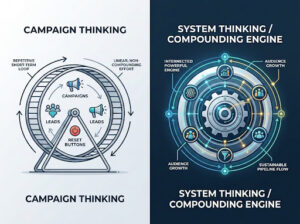
Campaign thinking asks: What are we running this quarter?
System thinking asks: What are we building this year that makes the pipeline more predictable for next year?
Campaign thinking asks: How many MQLs did we generate?
System thinking asks: What qualified pipeline did marketing create, and how does that compare to previous?
Campaign thinking asks: Which campaign performed best?
System thinking asks: What did the system learn? How does that learning impact what we build next?
The questions aren’t that different.
The consequences are.
The first set links directly to a campaign calendar. The second begins to deliver a demand-generation engine.
That difference was especially apparent in work that preceded a 350% growth in inbound SQLs. The campaigns themselves didn’t suddenly become extraordinary. The bigger change was in the question those campaigns were meant to answer.
The thinking shifted from asking whether individual activities were working to asking what the overall system was learning and whether those learnings were creating stronger qualified demand.
That’s the difference between optimizing activity and creating an engine.
Why the Demand Gen Thinking Problem Is So Hard to Fix
It’s easy to look at these patterns and blame the marketing team.
But that would be too simple.
B2B marketers are working within structures that often reward campaign thinking.
Let’s start with the quarterly reporting.
Results are reviewed by boards quarterly. Leadership meetings are held quarterly. Budgets are frequently allocated on a quarterly basis. The thinking for a campaign is naturally aligned with that rhythm.
System thinking does not.
A demand generation system can take years to become truly compounding, but the reporting structure keeps asking what happened in the last 90 days.
And then there’s how you buy marketing.
Many B2B companies effectively buy marketing as a collection of services: campaigns, content, paid media, events, social media, and email. When the organization buys marketing as a set of activities, it is very easy to think of demand generation as a set of activities.
The procurement model strengthens the mental model.
And then there is the most dangerous one the comfort of activity.
Progress can look just like being busy.
It’s obvious a team running five campaigns is working. A team stepping back to ask if those five campaigns are part of a coherent demand generation system can look like it’s doing less.
That is why the problem is not just a marketing problem.
This is a leadership problem.
The mental model of the CMO, CEO, and senior leadership eventually becomes the mental model the team operates within.
The One Demand Gen Question That Changes Everything
There’s one question I’d keep in the room for the next pipeline review:

Is our pipeline the result of what we have built or the result of what we are running today?
The difference between the two is massive.
If the pipeline is mostly what the team is working on now, the organization probably has a campaign calendar.
When the pipeline continues to benefit from what the organization has accumulated, learned and built over time, there is something closer to a demand generation system.
And if the question itself is hard to answer, that uncertainty can be telling you more than the dashboard is.
B2B Demand Generation: How Pipeline Is Really Built dives into the full architecture of what a demand generation system is and how it differs from a campaign calendar.
Curious what the shift resulted in practice? Check out the $40M Pipeline story.
The pipeline problem is almost never a pipeline problem.
It is a thinking problem, and thinking problems start at the top.