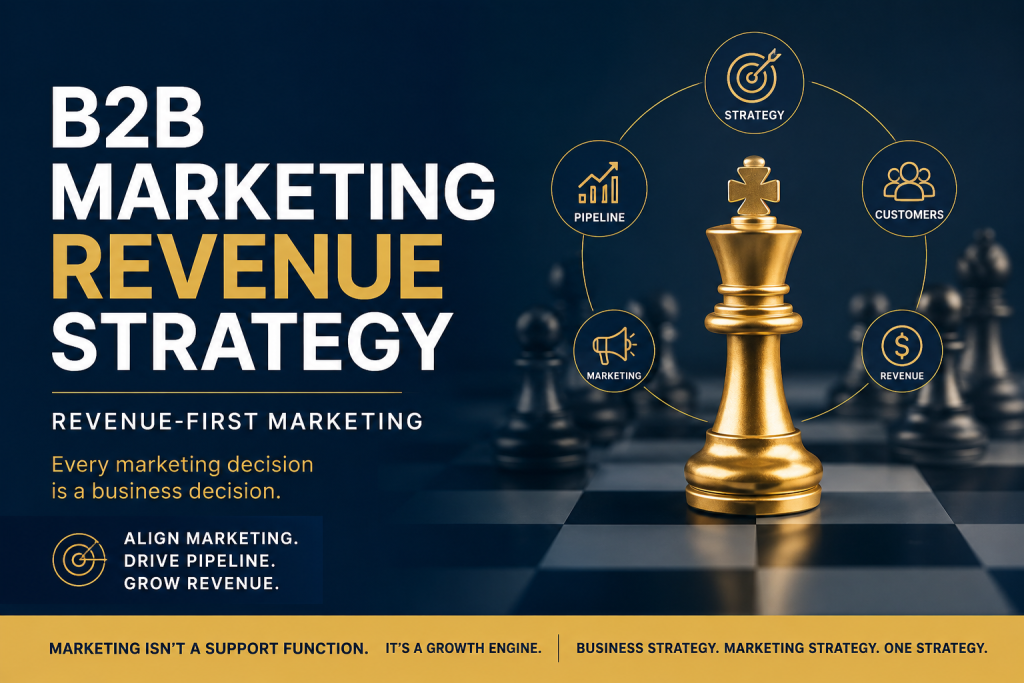
There Is No Such Thing as Marketing Strategy Without Business Strategy
They’re a B2B marketing revenue strategy that can’t be divorced from business strategy. In these organizations marketing is expected to influence the pipeline, impact commercial decisions, and contribute directly to revenue. Then there is another version, one where marketing is measured by campaigns, lead volume, and activity while the rest of the business is measured by growth. These two organizations are almost indistinguishable in terms of budget, technology, and team size. It’s all for accountability.
It’s an often unspoken distinction, but one that colors every conversation between marketing and the business. Leadership wants to know if the company is building predictable revenue. Marketing explains campaign performance, website traffic, and leads generated. Both are valid conversations, but they are not related. One is around business results. The other is on marketing outputs. That disconnect chips away at confidence over time, not because marketing is without capability, but because it’s seldom measured against the outcomes that matter most to the business.
The consequences are larger than most organizations realize. If marketing is a support function, then all decisions are about execution. These quarterly campaigns sacrifice the longer-term commercial view. It’s not how much you contribute it’s how much you do. The organization becomes good at producing marketing, but bad at producing revenue.
Companies with a sustainable pipeline market-building approach market differently. They understand that every decision around markets, customers, positioning, messaging, and demand generation is a business decision. Those decisions chart the direction of where future revenue will come from, what opportunities are added to the pipeline, and how the company is competing in the long term. Marketing is not just communicating the strategy, it is helping to shape it.
That’s what this page is about.
Over the past two decades I’ve become more and more convinced that one of the root causes of B2B pipeline failure is the separation between marketing strategy and business strategy. This isn’t marketing. It’s a leadership decision on what marketing is expected to own and what is success.
What follows is the philosophy that has informed my thinking about marketing not as a support function of the business but as a builder of the business. It is a point of view based upon commercial accountability, not campaign activity, and one that begins with a simple belief:
Marketing that cannot explain its contribution to revenue is not executing the wrong strategy. It is being held accountable to the wrong one.
The Accountability Gap
B2B organizations fail not for lack of talent, creativity, or execution capability from their marketing teams. They fail because marketing is charged with delivering a different set of outcomes than the rest of the business.
“Boardroom is all about revenue. Investors quantify it, founders dream of it, and leadership teams are expected to deliver it. However, marketing is often measured through a different lens campaign performance, website traffic, lead generation, content engagement, or marketing-qualified leads. These are useful measures of how the business is operating, but they are not the results the business exists to produce.
Trust diminishes in the space between marketing activity and commercial outcomes. Many promising B2B growth strategies lose energy at this point as well.
Marketing Reports Campaign Success. The Board Wants Revenue Confidence.

One of the most obvious signs of the accountability gap emerges in leadership reviews.
Marketing provides a detailed update on campaign, channel, event results, and lead generation. Often data-driven, holistic, and professionally executed. But then when you get up to the board, or senior leadership, the questions change very quickly.
What percentage of the qualified pipeline was marketing-driven?
Those initiatives created what opportunities in the sales pipeline?”
How much business did those campaigns generate?
This isn’t to undermine marketing’s work. They’re asking the business question behind the marketing activity.
The problem is that many organizations never create a system that translates campaign performance to commercial contribution. Marketing talks in execution metrics, leadership thinks in pipeline, revenue, and growth. Both are correct, but rarely do they meet in the same conversation. In other words, marketing is a defensive activity, and the business is trying to understand results.
The problem is not communication. That’s accountability.
Success Is Often Measured by Metrics That Do Not Create Revenue
All organizations are as you measure them.
If they are rewarded for getting more traffic to a website, that’s what they are going to invest in. The main objective is to create as many leads as they can. As MQLs become the definition of success, the organization naturally gets better at producing MQLs.
None of these is wrong necessarily.
The problem is when these metrics are used as proxies for commercial performance, rather than as indicators.
A business can have record website traffic and a flat, qualified pipeline. It can celebrate the higher lead volumes, while sales teams are still struggling with conversion quality. Marketing dashboards are getting better, quarterly reports are looking more impressive, and the commercial trajectory of the business is still the same.
This is not a marketing failure. That’s because the organization has rewarded optimizing proxy metrics that were supposed to influence the outcome but didn’t.
The metrics an organization chooses do more than measure performance; they shape priorities, investment decisions, and behavior. They decide what the marketing spends time creating and ultimately what the business gets out of it.
Strategy and Execution Are Treated as Separate Responsibilities
The third manifestation of the accountability gap is structural.
Marketing develops campaigns. Sales manages opportunities. Customer Success focuses on retention. Each function performs its role well, yet no single team is accountable for the complete commercial system that connects demand creation to revenue generation.
When strategy and execution are separated in this way, the pipeline becomes everyone’s responsibility in theory but no one’s responsibility in practice.
Marketing celebrates campaign launches. Sales focuses on closing opportunities. Leadership reviews quarterly revenue. The links between these activities are assumed rather than intentionally designed.
This is why organizations often respond to pipeline challenges by launching another campaign instead of examining the operating model that produced the problem in the first place.
The accountability gap is rarely marketing’s fault alone. More often, it reflects a leadership decision that marketing should support revenue rather than share responsibility for creating it.
That distinction changes everything.
When leadership expects marketing to own commercial outcomes instead of marketing activity, priorities shift. Planning changes. Conversations become more meaningful. Marketing and sales stop operating as adjacent functions and begin working as parts of the same revenue system.
Closing the accountability gap does not begin with a new campaign, a different dashboard, or another planning workshop.
It begins when leadership makes a conscious decision that marketing will no longer be evaluated by what it does but by the business outcomes it helps create. That decision becomes the foundation of a true B2B marketing revenue strategy.
What Revenue-Accountable Marketing Actually Looks Like

Closing the accountability gap is not about asking marketing to work harder. Most marketing teams are already working hard. The real challenge is asking them to work towards a different outcome.
Revenue-accountable marketing is built on a fundamentally different belief: marketing is not a department that supports growth. It is one of the business functions responsible for creating it.
That shift is neither tactical nor operational. It changes how the business plans, measures success, and defines the role of marketing. Over the last 20 years, I have found that organizations capable of building predictable pipelines almost always make three strategic shifts. They stop thinking in campaigns, they stop measuring activity as success, and they stop treating marketing strategy as something separate from business strategy.
Everything else is a consequence of those decisions.
Shift 1: From Campaign Planning to System Architecture
Most marketing plans begin with a calendar.
The discussion revolves around what campaigns will run this quarter, which channels will be used, and what assets need to be created. It feels like strategic planning because there is structure, timelines, and execution discipline. In reality, it is campaign planning.
Campaigns have a natural limitation they are designed to end.
A campaign launches, generates attention, produces results, and eventually gives way to the next initiative. Regardless of how successful it was, the organization begins the following quarter searching for another campaign capable of creating similar momentum. Growth becomes dependent on continually finding the next opportunity to generate demand.
Revenue-accountable organizations think differently.
Instead of asking, “What campaigns are we running this quarter?” they ask a far more valuable question:
“What are we building this year that will make next year’s pipeline easier to generate?”
That single question changes the role of marketing from execution to architecture.
Rather than investing exclusively in campaigns, the organization begins building assets and capabilities that become stronger over time. Thought leadership compounds into authority. Customer insights improve positioning. Content becomes a long-term demand generation asset rather than a one-time campaign deliverable. Sales enablement evolves continuously because every customer conversation strengthens the next one.
The objective is no longer to create isolated bursts of attention. It is to design a commercial system that becomes more effective with every quarter.
That is the difference between campaigns and systems.
Campaigns create moments.
Systems create momentum.
The distinction matters because sustainable pipeline is rarely the result of one exceptional campaign. It is almost always the product of infrastructure that has been deliberately designed to compound.
The $40 million qualified pipeline often becomes the headline because it is the visible outcome. What matters far more is what produced it.
It was not one campaign.
It was not one quarter.
It was not one marketing initiative that outperformed expectations.
It was the output of a marketing system where strategy, positioning, demand generation, sales alignment, measurement, and execution reinforced one another over time. Individual campaigns played an important role, but they were components within a much larger architecture. They created value because the system they operated within had already been designed to produce commercial outcomes.
This is where many organizations unintentionally limit their own growth.
They spend every planning cycle discussing what they are going to launch next instead of asking what they are building for the future.
Those are fundamentally different conversations.
One produces campaigns that end.
The other builds capabilities that continue creating value long after the campaign has finished.
That is the first principle of a B2B marketing revenue strategy. Marketing should not be designed to produce the next successful campaign. It should be designed to make the next quarter and the quarter after that easier to grow than the last.
Because businesses do not scale through campaigns.
They scale through systems.
Shift 2: From Activity Metrics to Revenue Metrics
The metrics a marketing team is held accountable for will always determine the system it builds.
This is one of the most overlooked truths in B2B marketing. Organisations often assume that metrics exist to measure performance after the work has been done. In reality, metrics shape the work long before it begins. They influence planning, investment, priorities, and behavior. In many ways, they act less like a scorecard and more like a blueprint.
A marketing team measured by website traffic will find ways to increase traffic. A team measured by lead volume will optimize for more leads. A team rewarded for MQLs will become exceptionally good at producing MQLs.
None of those outcomes are inherently wrong.
The problem is that they can all improve while the business stands still.
A company can report record traffic, celebrate higher lead volumes, and present impressive campaign performance yet still struggle to build a qualified pipeline or accelerate revenue growth. The marketing function appears successful because it is delivering exactly what it has been asked to deliver. The business, however, is looking for a different outcome.
This is why the metrics themselves deserve far more attention than the reports built around them.
The metric is not just a measurement. It is a design brief.
The moment leadership decides that marketing will be evaluated by qualified pipeline rather than campaign activity, the entire operating model begins to change. Planning discussions become more commercial. Budget decisions become more disciplined. Campaigns are judged by their contribution to revenue instead of their ability to generate engagement.
Equally important, the conversation between marketing and sales changes.
Marketing no longer presents campaign reports while sales presents revenue forecasts. Both teams begin discussing the same commercial objective. A qualified pipeline becomes a shared responsibility rather than a number that one department generates and another department inherits.
That shift is more significant than changing a dashboard.
It changes how the organization thinks.
Marketing stops asking, “How many leads did we generate?” and starts asking, “How much qualified pipeline did we help create?” The answer is no longer measured in marketing success. It is measured in business success.
That is the point at which marketing stops behaving like a lead supplier and starts operating as a revenue partner.
Shift 3: From Marketing Strategy to Business Strategy
The term “marketing strategy” suggests that marketing is a function with its own goals separate from the business as a whole.
I’ve never thought that.
All key marketing decisions are business decisions. Your choice of target industries determines where you will obtain future revenue. The problems you choose to solve define your competitive positioning, your pricing power, and the market perception of you. Your spending on each channel is going to determine how relationships are built and where demand will come from over the next several years.
These are not marketing decisions with business consequences.
They’re business decisions, made through marketing.
That difference matters for what we should expect of senior marketing leadership.
The quality of the campaigns, brand awareness or lead generation should not be the only metrics to measure a CMO’s performance. Those responsibilities are important, but they are the result of execution. The real responsibility of senior marketing leadership is to help the business make better commercial decisions where to compete, which customers to pursue, how to build demand, and how to create a more predictable revenue engine.
In other words, the role is strategic, not operational.
In looking back over the past 20 years, one pattern emerges more clearly than any campaign I have ever run.
With each promotion, there was a greater standard of accountability.
No one told me I’d be managing more campaigns now that I had been promoted.
They asked me to answer harder business questions.
Can marketing create a higher-quality pipeline?
Can it improve the quality of opportunities entering the sales process?
Can it drive commercial strategy, and not just deliver on it?
The expectation changed from delivery of marketing activity to delivery of business outcomes.
That’s what ultimately created the SVP role. The title was much more than a matter of precedence. It was about making them answerable. Responsibility was no longer confined to marketing execution. It covered commercial growth, strategic direction, and the decisions that shaped long-term business performance.
It is the same principle behind the Fractional CMO model.
A business doesn’t hire a Fractional CMO to run more campaigns. It does so because it wants a better commercial outcome. The engagement is measured by the quality of business decisions, the predictability of the pipeline, and the organization’s ability to grow, not by the volume of marketing activity churned out along the way.
That’s why I don’t differentiate between marketing strategy and business strategy.
The one is just the market expression of the other.
The moment a leadership team starts to think of marketing as a business function rather than a support function, the conversation changes. Busy is not marketing anymore. The value it creates is what it is judged by.
And that is as it should be.
The Question That Changes Everything
If I could ask a CEO or founder only one question about their marketing function, it would not be about campaign performance, brand awareness, technology, or budget.

It would be much simpler than that.
“What qualified pipeline did marketing contribute this quarter, and how does that compare to last quarter?”
That question reveals more about the maturity of a marketing organization than any dashboard ever will.
If the answer begins with a qualified pipeline number, followed by how that number has changed over time and what influenced it, the organization has already made an important shift. Marketing understands that its role is to contribute to commercial growth, not simply to execute campaigns.
If the answer begins with website traffic, MQLs, campaign performance, or lead volume, the organization is still measuring marketing independently from the business it is supposed to help build.
This is not because those metrics lack value.
They do.
Traffic helps explain visibility. Campaign metrics help improve execution. Lead generation helps measure demand creation. Every one of these indicators has a place inside a marketing function.
But none of them answers the question that matters most to a CEO, a board member, or an investor.
Did marketing help create future revenue?
That is the standard revenue-accountable marketing accepts.
It also changes the relationship between marketing and the rest of the business. Sales is no longer questioning lead quality while marketing defends campaign performance. Finance no longer struggles to connect marketing investment with commercial outcomes. Leadership no longer receives competing versions of success from different departments.
Everyone begins working towards the same objective.
The downstream impact can be significant. Organisations that align marketing around qualified pipeline rather than marketing activity create the conditions for stronger SQL growth, improved win rates, and more predictable revenue – not because they discovered a better campaign, but because they built a better business system.
Start with the conversation that matters most.
If you’ve read this far, you’ve probably figured out this is not another way to do marketing.
It’s a different way of doing business.
The point of this page is intentionally simple: marketing strategy is business strategy; there is no difference. The minute organisations stop treating marketing as a support function and start treating it as a business function, the conversation changes. Campaigns are part of the system. Marketing and sales begin to work to the same commercial objective. Leaders measure marketing by its contribution to a qualified pipeline, not by the volume of activity it generates.
All else is a result of that decision.
The articles in this category explore that philosophy from different viewpoints. Some are system-based rather than campaign-based. Some look at accountability, leadership, pipeline, and the commercial choices that mean marketing creates measurable business value. They’re all designed to challenge a belief that’s shaped B2B organisations for years: marketing is responsible for promotion and the business is responsible for growth.
I don’t think you can divorce those responsibilities.
Start Here
If you’re new to this category, begin with the article that lays the foundation for everything else.
Start with: What $40M in Qualified Pipeline Actually Taught Me – It Wasn’t What I Expected
Which is why you don’t see a reliable pipeline from one successful campaign to the next. It’s a product of a changing system and a leadership team that needs marketing to deliver business growth and not just marketing activity.
If Marketing Can’t Answer the Pipeline Question, It’s Time to Change the Conversation
If your marketing function continues to define success by campaigns, lead volume, or traffic, the problem is unlikely to be lack of effort or ability.
More often it reflects the accountability framework that the organization has put in place.
That paradigm doesn’t get fixed with another marketing program.
The genesis of this is a leadership decision that marketing has to be measured in the same commercial terms that matter to the rest of the business.
If that is the conversation your organization wants to have, let’s have it.
If your marketing can’t answer the pipeline question, let’s fix that.
Whether you are a founder looking to build predictable pipeline, a CEO redefining the role of marketing, or a board evaluating commercial performance, the goal is the same: build a marketing function that earns trust by creating measurable business outcomes.
Because revenue-driving marketing doesn’t have to justify its value.
The business is already aware of it.
Final Thought
Marketing that cannot explain its contribution to revenue is not a strategy problem.
It is an accountability decision. And accountability decisions start at the top.