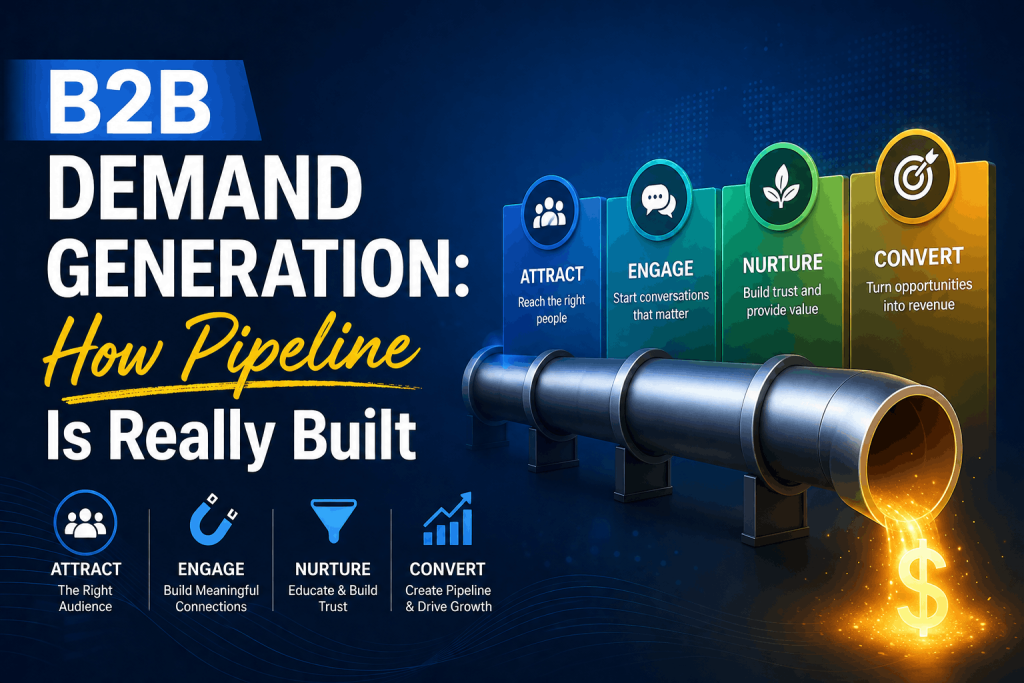
Most B2B companies don’t have a demand generation programme. A calendar for their campaign has a demand generation label on it. The semantic difference is not. That’s the difference between a pipeline that compounds and a pipeline that resets every quarter.
After years of pipeline building, there’s one conviction that never changed: a B2B demand generation strategy should be building qualified pipeline, not better reports. That’s the core of my demand generation philosophy. There are just two types of demand generation. You build momentum that builds quarter over quarter. The other creates dashboards that look good until the next quarter. Most organizations are running the second version but think they’ve built the first.
I’ve never judged demand generation success on how busy the marketing team appears to be or how many campaigns are scheduled. I judge it by a much simpler question: Does the work you’re doing today make it easier to create a qualified pipeline tomorrow? If the answer is no, then you haven’t built an engine. You created a campaign calendar with a different name.
Here’s what I’m thinking about how to build the real thing. Not the campaign. The engine.
Why Most B2B Demand Generation Fails
The minute I stopped thinking about demand generation as a series of campaigns and started thinking about it as a system, there was one thing I could not ignore. Most B2B companies don’t have unique demand generation problems. They make the same mistakes, only differently.” I’ve seen those patterns in growing companies, established organizations, and ambitious marketing teams alike. The names are changed. The symptoms vary. The root causes are rare.
The first mistake I see is that demand generation is seen as a campaign function rather than a system function. The discussion is about quarterly launches, campaign calendars, and short-term targets. One campaign finishes, and another begins, like the last quarter never happened. Nothing is designed to compound; everything is designed to deliver a result within a reporting period. B2B pipeline building feels inconsistent because of this. Every quarter is year one.
The second mistake is the definition of success. I’ve never felt that MQLs, website traffic, or campaign engagement tells me if demand gen is working. Marketing has been on, they say. They don’t tell me if marketing has generated a qualified pipeline. I’ve been to enough pipeline reviews to know that dashboards can get better and commercial performance can stay exactly where it was. Organizations become remarkably good at manufacturing the numbers they want to celebrate, even if those numbers have very little to do with revenues.
The third mistake is the one that silently disconnects marketing from commercial results. I have been in far too many meetings where marketing has brought in lead reports and sales has done pipeline reviews. Both sides feel they are talking about growth. They’re not talking about the same thing. Ownership disappears somewhere between creating interest and creating revenue. Marketing says they have sent out the leads. “The leads were not ready,” says Sales. The system becomes the solution. The explanation becomes the hand-off.
I have come to think that these three problems almost always go together. Changing campaigns won’t fix them, because the campaigns didn’t make them to begin with.
The fix is not a better campaign. It is a different mental model.
The Demand Generation Engine: How It Actually Works
I’ve never believed that the way to create effective demand generation is to add more campaigns. I’ve only seen it when the business buys into building a system. The difference between activity and momentum. Campaigns can produce short-term results. Systems produce results that are more easily repeatable because each piece supports the next. There are three components to every B2B demand generation strategy that I trust. Take one away and it is no longer an engine. You have marketing activity that looks productive but does not compound.

A Pipeline Thesis
The first thing I want to know is not what channels a company uses. It’s about whether the company has a clear point of view on who should become a qualified pipeline and why.
My experience has been that the best demand gen engines begin with a pipeline thesis. There needs to be absolute clarity on which accounts matter and how marketing will set the conditions for those opportunities to exist before any discussion of campaigns, content, or technology. Without that, channels are guesses, not decisions.
Which is why I’ve never considered ABM strategy to be a channel. To me, it’s a thesis operationalized for a pipeline. When the thesis is clear, the execution is much clearer because every marketing decision serves the same commercial objective.
The 40% year-over-year pipeline growth I’ve seen didn’t start when we launched ABM. It started when the pipeline thesis became clear. ABM just put an operating model to that thinking. That growth didn’t prove that ABM works. Proof that strategy should be the driver of channels and not the other way around.
A Measurement Architecture
The second thing is visibility. I’ve learned you can’t improve a pipeline you can’t see.
When I stopped asking marketing to prove it was busy and started asking it to prove it had contributed to the pipeline, one of the biggest changes in my own demand generation philosophy occurred. Campaign metrics have their place, but they aren’t the end point. Activity is explained by MQLs, clicks, and traffic. Outcomes explained by SQLs, pipeline contribution, and commercial impact.
That change completely changed the optimization of the organization. We tracked SQLs, not MQLs. This helped us grow B2B inbound SQLs by 350%. I watched other teams celebrate healthy lead reports and spent the same time wondering why the pipeline was not growing. The difference wasn’t in the effort. It was a measure. What I’ve seen is that organizations tend to get better at the metric that they reward.
A Compounding System
The last piece is the one I believe most companies overlook, because it takes patience before it gains momentum.
Campaigns get results while they are running. Systems keep on delivering results long after the campaign is over because each investment feeds the next. Content becomes an asset, not a deliverable. Brands become familiarity, not awareness. Process is about consistency, not constant reinvention. Here is what compounding looks like.
The hardest lesson I learned was that compounding rarely looks impressive in the first year. Most organizations throw the system away because it looks too slow. They change agencies, switch campaigns, or change strategy before momentum has a chance to build. The irony is that the reset becomes the very thing preventing the results they’re searching for.
It was not one stellar campaign that resulted in a $40M qualified pipeline. It came from a system that took close to a year and a half to get a discernible shape, then compounded over the next three years. That’s the lesson I took away with me. It’s not about the number. The compounding is.
What This Means If You Are a CXO or Founder
If you’re running a business, there’s one question I’d encourage you to ask your marketing leader every quarter.

What qualified pipeline did marketing contribute this quarter, and how does that compare with the last quarter and the quarter before?
No questions on how the campaign is doing. Don’t ask for lead volume. No need to ask how many webinars were run or how many downloads were created. Inquire about the qualified pipeline. If the answer quickly devolves into an MQL report or a dashboard of marketing activity, then you don’t have a B2B demand generation strategy. You have a campaign calendar that is named differently.
The price of that approach is more than most leadership teams realize. Every quarter starts at zero. Budget approved. Campaigns are launched. Reports are presented. And the cycle begins again because nothing has been designed to compound. At some point, the board conversation becomes defensive rather than strategic as marketing is explaining activity and the business is asking about the pipeline.
I have seen how it looks when the system is built differently. Buyers come with context, not confusion. Sales conversations get shorter because prospects are already educated. The cost per SQL declines because the engine becomes more efficient, not more costly, over time. And that’s when I’ve seen commercial performance start to improve as well. A more powerful demand generation system creates more opportunities; it creates better opportunities, and that’s why I saw win rates increase 50%. The improvement wasn’t driven by better sales conversations alone. It was much earlier with better demand generation.
If you’re responsible for growth, I challenge you to look beyond campaigns and ask yourself, have you built a system that your team can protect for years, not quarters? Demand gen rarely fails because marketers lack talent. It doesn’t work because leadership keeps restarting the engine before it can compound. That system needs to be protected, and that is a leadership decision, not a marketing decision.
Where to Go Next
If this page has changed your thinking on demand generation, please don’t stop here. This pillar page is the basis for my thinking.
Start with the first post, “What $40M in Qualified Pipeline Actually Taught Me – It Wasn’t What I Expected.” That’s where I explain the experience that shaped everything you’ve read here.
If you’re thinking about your own pipeline, and not the theory behind it, let’s have that conversation. While every business is unique, the fundamentals of a compounding demand generation engine are surprisingly consistent.
Pipeline is not a sales problem. It was never a sales problem. It was always a systems problem. And systems are what I build.