Most founders approach the Fractional CMO conversation with the wrong frame. They are thinking, “I need a CMO, but I can’t afford a full-time one, so I’ll get a part-time version.” That frame leads to the wrong hire, the wrong expectations, and almost always, the wrong result.
I understand why cost is in the conversation. Building out senior marketing leadership is a big investment for a growing B2B company. But viewing a Fractional CMO through the lens of affordability misses the more important question: What kind of marketing leadership does the business really need?
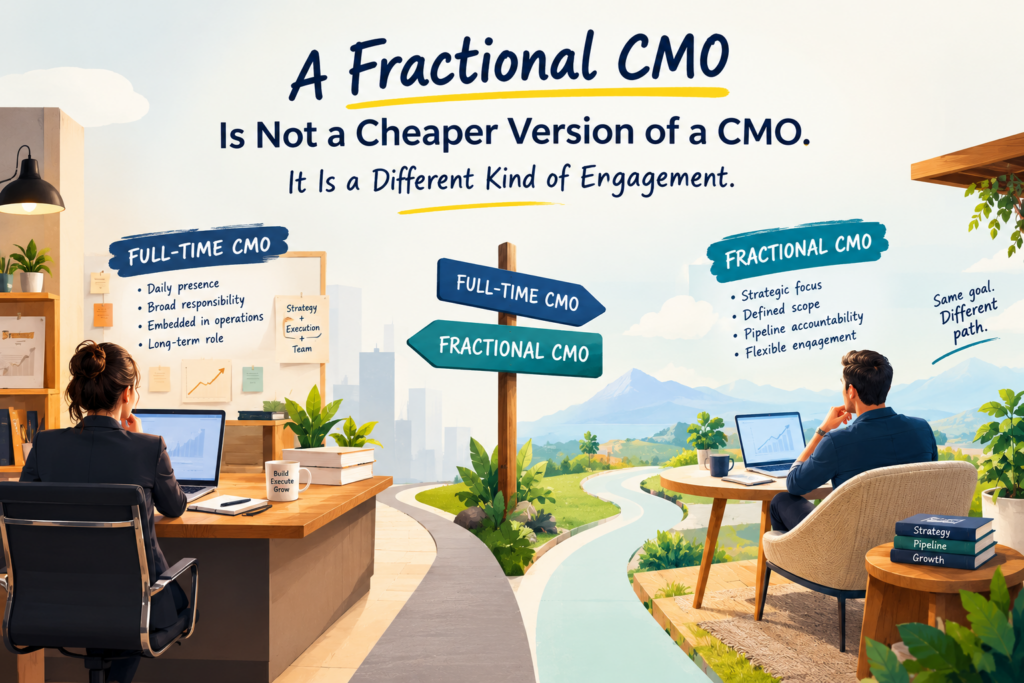
A Fractional CMO is not supposed to do the same amount of work in less time than a full-time CMO. The engagement has a different scope, cadence and accountability structure. Those gaps define what the model can do and what the company needs to be ready to do.
The Fractional CMO is not a less expensive CMO. It’s a different kind of engagement. It’s the understanding of the difference that makes the engagement.”
What Makes a Fractional CMO a Different Engagement?
The Fractional CMO model is different from a full-time appointment in three structural ways. Each alters what the engagement can produce and what the company must contribute to be successful.
1. A Fractional CMO Works Within a Different Time Horizon
A full-time CMO is in the office every day, involved in operational decisions and available for constant conversation across the organization. A Fractional CMO operates on a cadence that is typically two to three days a week or a similar schedule.
It’s not just a matter of reduced availability. It is a conscious design guided by strategic direction, decision-making, and accountability rather than continuous operational presence.
The company should be able to perform between assignments. Things get slower when every decision has to wait for the Fractional CMO to be available. The problem is not necessarily the engagement model, it might be the inability of the organization to function without constant senior intervention.
2. A Fractional CMO Has a Deliberately Defined Scope
A full-time CMO can develop into more operational duties as he/she is embedded in the business. A Fractional CMO engagement should have sharper boundaries.
Usually, that’s the marketing strategy, demand gen, qualified pipeline accountability and building the system that connects marketing activity to revenue. Execution remains with the internal team or the agency led by the Fractional CMO.
That is a difference. A strategy is only as good as someone who can put it into action. Without a team or agency to implement, a Fractional CMO is left to make recommendations that never see operational reality.
Before you hire, the company needs to determine who will implement the strategy, who will make the day-to-day decisions, and whether or not the existing team can deliver.
3. A Fractional CMO Has a More Specific Accountability Model
A full-time CMO could lead all marketing functions, including strategy, execution, team culture and the bottom line. A Fractional CMO engagement can be focused around a more specific outcome, the most common being a qualified pipeline.
This specificity allows for the evaluation of engagement. Before the work starts, both sides should have a common understanding of what success is, what results are expected, and how the progress will be reviewed.
That doesn’t mean a Fractional CMO can guarantee a pipeline or control all aspects of revenue. Sales execution, product-market fit, pricing and market conditions matter too.
The point is to create meaningful accountability and not to rely on activity reports, campaign numbers, or vague expectations of better marketing.
What a Fractional CMO Can Produce That a Full-Time Hire Often Cannot
The constraints of a Fractional CMO engagement can create advantages that are less natural in a traditional full-time appointment. These advantages are real, but they depend on the company’s readiness to use them.
-
Cross-company pattern recognition:
The Fractional CMO who moves between several organizations is able to see patterns that are harder to spot from inside one business. They can tell you what B2B demand generation tactics are generating qualified pipelines, what account-based marketing (ABM) efforts are generating meaningful opportunities, and what reports are masking poor commercial results.
This perspective can help to speed up the diagnosis. The Fractional CMO may use their relevant experience to challenge assumptions and find where the real problem lies, rather than treating each marketing problem as unique.
-
Less exposure to internal organizational politics:
A fractional CMO generally relies less on internal hierarchies and promotion decisions for a long-term career. That distance can make difficult conversations more direct, particularly when a review of a pipeline shows a mismatch between marketing activity and business results.
But independence only serves when leadership is prepared to listen to inconvenient findings. However, if a company punishes honest reporting, it is unlikely to benefit from it, whoever fills the position.
-
A potentially faster route to strategic clarity:
The scope and accountability of the Fractional CMO engagement are defined, so it can get to the big decisions faster than a full-time appointment that spends its first months learning the organization, building relationships and navigating internal processes.
There is no guarantee that applies to all. The company needs to provide relevant data, decide quickly and support implementation. If these conditions are not met, the Fractional CMO model loses much of its potential advantage.
When a Fractional CMO Is the Wrong Choice
The Fractional CMO model isn’t right for every business. Understanding where it works is as important as recognizing the situations in which it fails.
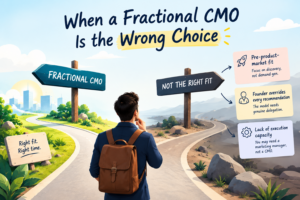
1. The company has not reached product-market fit.
Understanding customer needs, refining positioning and determining if the offering solves a meaningful problem are key challenges when the product is not yet defined. If you create a demand generation system before you have the answers to those questions, you risk amplifying the wrong message.
At this stage, a senior marketer who can collaborate closely with customers on positioning, messaging, and product feedback might be a better bet than a Fractional CMO focusing on pipeline architecture.
2. The founder will override every recommendation.
If the founder makes every marketing decision regardless of the data or advice given, it’s impossible for a Fractional CMO to provide meaningful strategic leadership.
The result is predictable: disagreement over priorities, slow implementation, and accountability without authority. The interaction becomes a source of friction, not a mechanism for improving pipeline performance.
The model requires actual delegation of the agreed strategic marketing scope. Founders need to stay in the business direction but need to let the Fractional CMO take the lead on the responsibilities given to them.
3. The real problem is a lack of execution capacity.
Some companies don’t need a fractional or full-time CMO. They are looking for a competent Marketing Manager to run campaigns, work with agencies, keep processes running and deliver an established program consistently.
It is a category error to bring in senior strategic leadership when the real gap is in operational execution. A Fractional CMO can lead execution, but don’t expect them to replace the entire marketing team.
First, close the execution gap. When it is most needed: strategic leadership
The Fractional CMO is not right for every company or every stage. The companies that benefit the most from it are the ones that pick the model because that model suits their needs, not simply because it suits their budget.
The Question to Ask Before Hiring a Fractional CMO
Before you compare candidates, ask one question about fees or engagement structures:
Do we need someone to own our demand generation strategy and hold us accountable to the pipeline, or do we need someone to build and run our marketing operations day to day?
The first answer is a Fractional CMO, assuming the company has the team, authority and execution capacity to support the engagement.
The second is a full-time marketing person with the operational skills to run the program.
There is no better choice per se. The right decision is dictated by the gap the business needs to close.
For a broader view of the role, expectations, and engagement structure, read the Fractional CMO for B2B. You can also explore The Moment a Founder Needs a Fractional CMO for the circumstances that often prompt this decision.
If you are weighing the options for your own business and want to discuss whether the model fits your situation, get in touch through the Contact page.
The wrong frame = the wrong hire. Get the framing right first. The rest are all from there.