
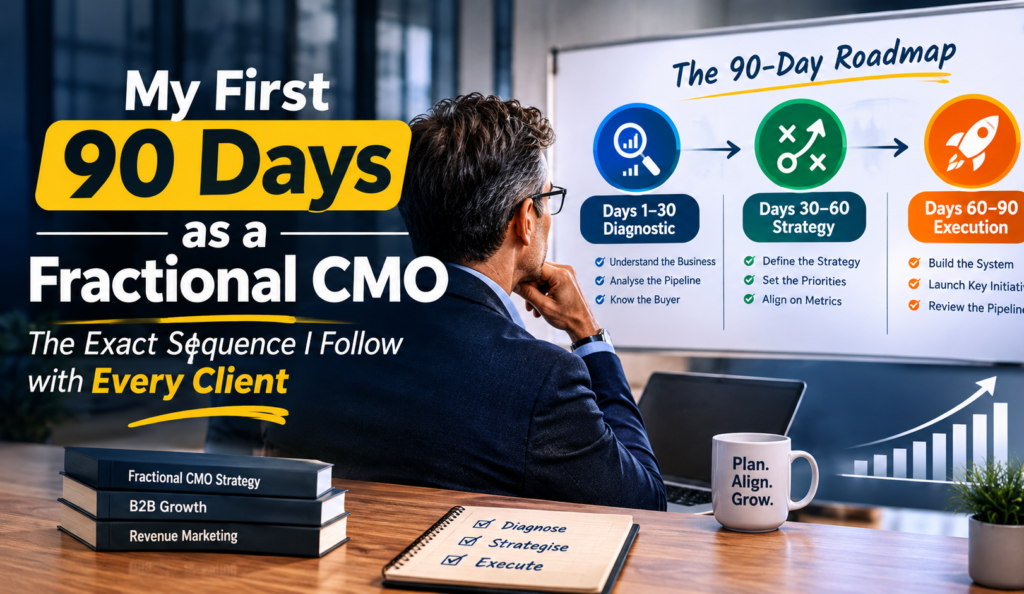
Every Fractional CMO Engagement So I assume it starts the same way: 30 days of listening before one campaign brief is written, one channel is recommended or one hire is suggested. This is no prudence. It is the only way to create something that works.
Typically, when a company hires senior marketing leadership, the immediate expectation is execution. The founder wants more leads, sales wants a better pipeline, and leadership wants to see marketing prove results quickly. I get the urgency, but often the wrong response starts with execution.
The key principle in my approach to the Fractional CMO First 90 Days is to understand the business before changing its marketing. I need to understand what is going on in the pipeline, who is buying the product, how sales actually works and where marketing is falling short of revenue expectations.

I have seen the importance of this understanding. As I explain in The Moment a Founder Realises, the disconnect between marketing activity and business growth often only becomes apparent when someone looks at the entire revenue picture.
Execution is faster due to the diagnostic phase. Without it, execution may be swift, but there’s no guarantee that it’s solving the right problem.
In The Moment a Founder Realises They Need a Fractional CMO, I discuss why founders eventually come to the realisation that more marketing activity does not always lead to business growth.
Days 1-30: The Diagnostic Phase of the Fractional CMO First 90 Days
The first 30 days I spend almost entirely trying to understand the business. I do not come in with a pre-designed marketing strategy or assume that the company’s existing problems have obvious solutions.
My Fractional CMO 90-Day Plan starts with five areas of investigation.
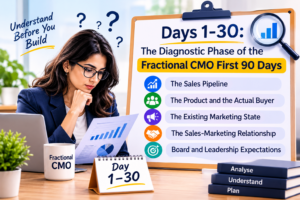
1. The Sales Pipeline
I begin with the actual sales pipeline, not the marketing dashboard. I look at what opportunities are entering the pipeline, how long they stay in each stage, where deals are getting stuck, and how many are eventually converted into customers.
I compare leads generated to opportunities accepted by sales. A company could be reporting increasing lead numbers while the qualified pipeline is flat.
This shows me what marketing needs to be producing. The goal is not just to create more enquiries, it is to create opportunities that have a realistic chance of becoming revenue.
2. The Product and the Actual Buyer
Then I look at who is buying the product, why they are buying it, and what makes them stay or leave.
I don’t rely solely on the ideal customer profile (ICP) document. Instead, I look at sales call recordings, talk to customer success teams, review feedback from clients, and read post-mortems from churned customers.
What language do they use to describe their problems, what objections do they have before buying, and what results do they want after they become customers?
The difference between the assumed buyer and the actual buyer can entirely change the marketing direction of the company. This is why I make buyer research a critical part of the Fractional CMO First 90 Days.
3. The Existing Marketing State
I look at what the marketing team is doing now, what channels they use, what each activity is optimised for, and how performance is measured.
I compare those metrics to the pipeline findings from the first step.
For example, a team could be assessed on website traffic, social engagement, downloads and MQLs (marketing qualified leads). Those numbers may be encouraging, but they don’t automatically tell us if marketing is driving qualified opportunities.
I’m looking for the space between marketing activity and commercial outcomes. Many teams are generating the right things for the wrong question.
4. The Sales-Marketing Relationship
I look at how frequently sales and marketing communicate, what information they share, and whether both teams are working off the same pipeline data.
I am also interested in what sales people say about lead quality and if marketing receives feedback on rejected or stuck opportunities.
This is useful in finding the accountability gap. If marketing measures volume and sales measures revenue, both teams can look good without agreeing on what really needs to improve.
5. Board and Leadership Expectations
Finally, I speak with the founder, CEO and relevant leadership stakeholders to understand what they expect marketing to deliver in the next 12 months.
I distinguish between what is in the initial engagement brief and what leadership expects to see in the next quarterly review.
These expectations are not always identical. One conversation may be around brand visibility, another shows an immediate expectation of qualified pipeline growth.
I need both expectations to be clear before I define the strategy.
And by the end of these 30 days, I want a clear picture of the business, its commercial priorities, and the problems marketing must solve. This diagnosis is the foundation of my Fractional CMO First 90 Days and prevents me from making costly decisions based on assumptions.
Days 30-60: Defining the Strategic Direction
Once the diagnosis is complete, I move into strategy. The results from days 1-30 are the basis for every decision I make in this period.
Here I develop the company’s Fractional CMO Strategy on three major decisions.
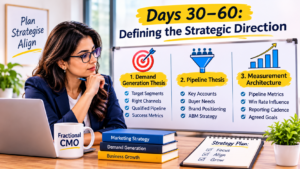
1. The Demand Generation Thesis
I decide which customer segments the company should target, which channels are best suited to those buyers, and what qualified pipeline generation should entail.
I also explain how success will be measured.
For example, if you find that enterprise buyers need multiple conversations and a lot of evidence before they will engage, then I wouldn’t recommend treating high volume lead generation as the primary growth strategy.
Instead, I would build a demand generation approach around reaching the right decision makers, building buyer confidence and creating opportunities that sales can realistically convert.
This is a working thesis, not a document that gets approved and filed away. I would expect to see it tested, measured and refined over the next 12 months.
2. The Pipeline Thesis
For companies at the right stage, I go deeper into the specific accounts that should enter the pipeline in the next 12 months.
I look at which accounts represent the biggest commercial opportunities, what problems those organisations are trying to solve and what needs to be true about the company’s brand before those buyers will engage.
That’s where account-based marketing (ABM) can come into play.
But I don’t just bring in ATMs because they’re popular or the company wants to go after enterprise accounts. First, I determine if the business has the right market, sales capacity, resources and account-level opportunity to justify it.
3. The Measurement Architecture
I establish the measurement framework that connects marketing performance with revenue outcomes.
These metrics could be sales qualified leads (SQLs), qualified pipeline contribution, opportunity progression or marketing’s impact on win rates depending on the business.
I also define what current metrics to keep, what current metrics need to change and how marketing and sales will jointly report on performance.
During this period, I get these definitions agreed upon in writing. I do not wait for the six-month review to talk about measurement.
That’s what makes my Fractional CMO Strategy commercially accountable and not just activity-based.
By day 60 the company should know which markets it wants to target, how it plans to create qualified demand and how it will measure progress. These decisions give a clear direction for the next phase of the Fractional CMO Engagement.
Days 60-90: System Design and Early Execution
By day 60, I have a diagnosis, a strategic direction, and an agreed measurement architecture in place. Now I can begin to design the systems that will consistently implement those decisions.
In this part of my Fractional CMO 90-Day Plan, I concentrate on three things.
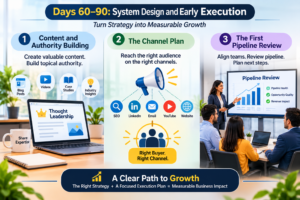
1. Content and Authority Building
I identify what the brand needs to own, the level of expertise to establish credibility and the publishing approach that can compound over the next 12 months.
I don’t just make up some random content calendar.
First, I determine what the target buyer needs to know before considering the company’s product or services. Then I figure out what questions, industry problems and decision-making problems the brand should address.
The goal here is to establish topical authority and position the company as a trusted source of information within its market.
This could include thought leadership, research-based articles, case studies, industry perspectives and content to support the sales process.
2. The Channel Plan
I finalise the channel priorities based on what I learned about the buyer in the first 30 days.
I think about where decision makers spend their time, how they research solutions, what impacts their purchasing decisions and which channels can realistically reach them.
The company may already be using the best channels. In some cases I suggest changing the mix.
I don’t keep investing in a channel just because the company always has. Every channel needs a defined purpose, tied to the demand generation thesis.
This is an important part of the Fractional CMO’s first 90 Days because channel decisions should be based on buyer evidence, not personal preference or industry patterns.
3. The First Pipeline Review
By day 90, I bring marketing and sales for their first formal pipeline review.
This is not a report of the campaign performance. It’s a conversation about the real pipeline, the opportunities we’re creating, the quality of those opportunities, and the progress we’re making toward commercial goals.
I want both teams looking at the same numbers and talking about the same business outcomes.
The meeting is almost always awkward. The baseline is often more adverse than either side anticipated. Marketing may realise its lead generation has not translated into enough qualified opportunities, while sales may recognise that it has not provided sufficient feedback or visibility.
“I think we need this discomfort.
For the first time, the accountability gap is being discussed openly, rather than hidden behind separate departmental reports.
The baseline set in this review is the point of reference to measure future performance.
That’s what the Fractional CMO First 90 Days really accomplishes: not an awesome set of campaigns, but a working direction, a clearer operating system and shared accountability.
What the Company Needs to Bring to Make This Work
The first 90 days are not all on the Fractional CMO. The company also needs to contribute if the Fractional CMO Engagement is going to drive meaningful results.
I need 3 things from every company I work with.
1st, founder or CEO commitment: Leadership must be willing to hold marketing accountable for pipeline outcomes and protect the agreed direction from the quarterly urge to change everything. A strategy cannot compound when it is constantly reset.
2nd, access to actual sales data: I need visibility into the actual pipeline, deal progression, sales conversations, and feedback from clients. Filtering a CRM report alone is not sufficient to know what is going on.
3rd, patience during the diagnostic phase: The company has to let the focus be on understanding and not on immediate campaigns and deliverables for the first 30 days.
I’ll be honest, most companies find this initial period frustrating. They hire a Fractional CMO because they want someone to build things, but instead that person starts asking questions, reviewing data and challenging existing assumptions.
I do not view that friction as a failure of the engagement. It’s the diagnostic working as it should.
To avoid costly decisions made with incomplete information, the Fractional CMO First 90 Days were created. This program creates the understanding needed to make the next 12 months more focused, measurable and commercially relevant.
If your company is exploring this approach to marketing leadership, I would encourage you to understand how a structured Fractional CMO Strategy works before beginning the engagement. You can check out my Fractional CMO forB2B and contact me to discuss your business requirements.
The 90-day sequence exists for one reason: guessing is more expensive than understanding.