Most B2B companies that have dabbled in Account-Based Marketing (ABM) will tell you the same thing: it sounded right, it looked sophisticated in the planning deck, and it delivered less than expected.
The campaigns went on. The personalisation was genuine. The content was the right one for those accounts. And the pipeline didn’t budge.
I don’t believe such a scenario occurs because most marketing teams are incapable of implementing an ABM strategy. I think they begin with the wrong question.

Instead of asking which accounts are really worth winning, they ask how to get to a chosen list of accounts. That distinction is the key difference.
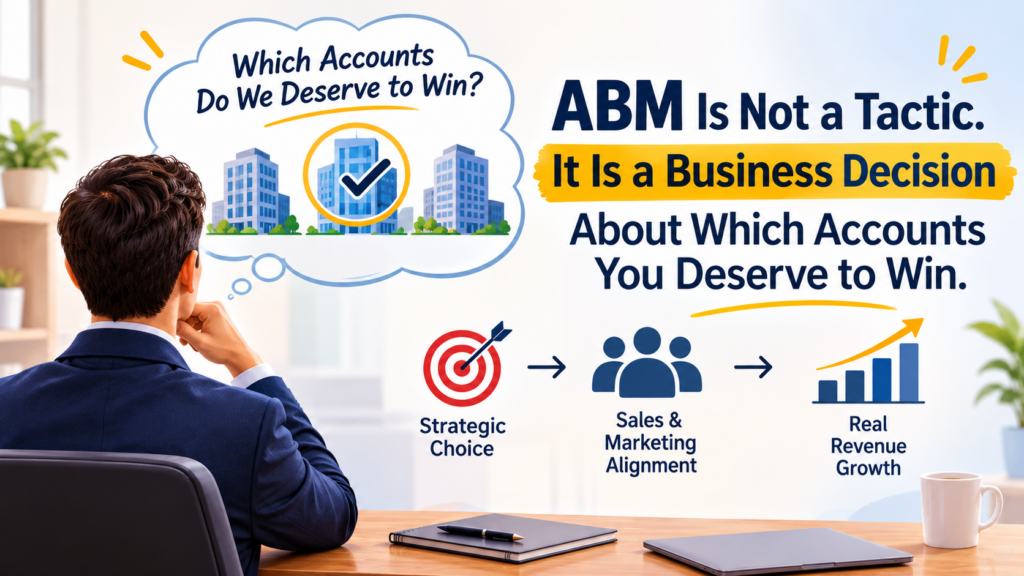
Account-Based Marketing fails when companies treat it like another marketing tactic. “Personalised emails, targeted advertising and account-specific content cannot replace a clear business decision.
Companies that have achieved 40% year-on-year pipeline growth know something different. ATM is not a campaign plan. It’s a revenue ambition.
The Difference Between Account-Based Marketing as a Tactic and a Business Decision
There are two very different approaches companies take to Account-Based Marketing. Both can employ the same terminology, technology and campaign formats, but they operate on entirely different assumptions.
-
ABM as a Marketing Tactic
The old way was the marketing team would create a list of accounts based on Ideal Customer Profile (ICP) attributes. It selects companies by industry, company size, revenue, geography and other qualifying characteristics.
When the list is ready, the team prepares personalised campaigns for these accounts. It produces targeted content, runs advertising campaigns, tracks engagement, and monitors intent signals.
The team then evaluates the programme using pipeline influence, engagement rates, website visits, and other marketing metrics.
There is nothing wrong with these activities in themselves. The issue is they begin without a larger business decision.
The account list is really a marketing artefact. Marketing decides who to target and builds campaigns and then expects the sales team to turn the interest into opportunities.
-
ABM as a Business Decision
Another approach begins with a question from leadership:
If we win these accounts in the next 12 months, what would really change our revenue trajectory?
The answer has to be specific. Not an industry or a broad customer segment, but real company names with clear reasons why you would go after them.
Perhaps one account will open up a whole new market for you. Another could lend credibility in an industry the firm wants to enter. A third could be a large recurring revenue opportunity.
This is why B2B account-based marketing becomes a business priority and not just a marketing activity.
The job of marketing is to create the conditions whereby these accounts want to engage. Sales, leadership and other appropriate teams all work to the same outcome.
The account list is no longer the property of marketing. This is decided at the company level, agreed upon between the CEO and the head of sales before the first campaign starts.
That ownership difference changes everything downstream from messaging to resource allocation to sales conversations to revenue expectations.
What an Effective ABM Strategy Actually Requires
Account-Based Marketing should be approached as a business decision. But it requires three concrete commitments that many organisations are not prepared to make.
1. A Pipeline Thesis, Not Just an ICP
An ICP describes what kind of company could be your customer. A pipeline thesis tells you which specific accounts you have a credible right to win and why you are likely to win them.
These are not the same.
A company could be a great fit for your ICP but might not have an immediate reason to look at your solution. Maybe another company is a much better opportunity because its business priorities, challenges and growth plans are a better fit for what you can offer.
Finding those opportunities is the first step in a successful ABM strategy.
You need to be able to name the accounts, explain why they matter, understand what makes your company relevant to them and what winning them would mean for the business.
The thesis needs to be specific enough to be challenged. If leadership can’t explain why a particular account is on the list, it probably shouldn’t be.
2. Sales and Marketing Must Own the Same Accounts
One of the biggest problems with ATMs is that sales and marketing are often working with different priorities.
Marketing might be looking at 50 accounts with engagement potential, while sales might be looking at 20 different companies because of existing relationships or commercial opportunities.
Both teams may think they are running an account-based programme, but in effect they are running two separate programmes under the same name.
Before the first campaign even starts, true ABM and revenue alignment require shared ownership.
Sales must provide account intelligence and relationship history and commercial context. Marketing needs to understand the buying environment and develop the right approach to create meaningful engagement.
A kickoff meeting or a shared spreadsheet won’t get you that alignment. It takes continuous collaboration, shared priorities and accountability for those same accounts.
3. A Long Enough Time Horizon
Account-Based Marketing is not a 90-day campaign with a different moniker.
It takes time to build relationships with high-value accounts. Several stakeholders have to acknowledge your expertise, value and gain confidence in your ability to solve their problems.
Because of this, a serious ABM strategy should be run over a 12-18 month horizon.
The 40% year-on-year growth in the pipeline that I was referring to was based on a programme that took 18 months to implement before we could see the full effect.
To evaluate such a programme after 90 days is to judge a long-term revenue investment on short-term campaign expectations.
The question isn’t whether every account created an immediate pipeline. It’s about whether the company is building meaningful relationships with the specific accounts it has decided are worth winning.
Why Account-Based Marketing Is a CEO’s Decision Wearing a CMO’s Label
Most mediocre Account-Based Marketing programs have one thing in common: they start in marketing and never become a company decision.
The CMO creates the programme. The budget is approved by the CEO. Sales is notified. Marketing begins building campaigns.
But nobody asks the question that’s really important:
Which accounts should we be winning, and are we building the type of company that can win them?
That’s not a marketing question.
This is a product question. Are these accounts a place where the company can truly bring something of value?
That’s a question of pricing. Is its business model competitive for the type of business it wants to attract?
It’s a brand issue. Does the market believe the company is credible enough to work with these organisations?
And it’s a revenue strategy problem. Would winning these accounts bring the business closer to where leadership wants it to be?
The CMO can host that conversation, bring the data, and build the framework of execution. But only the CEO can make the underlying business decision.”
This is an important implication for marketing leaders. The most valuable ABM strategy conversation is not with your demand generation team. It’s with your CEO.
If your target account list came directly out of a data tool rather than a strategic leadership discussion, you are running a marketing tactic, whatever you want to call it.
This is another reason why ABM and revenue alignment cannot be a reporting exercise. It must shape the markets the company pursues, its spending, and its desired reputation.
The Question That Should Start Every ABM Programme
Before you go and build another list of accounts, design another personalised campaign or spend your budget on another marketing platform, bring one question to your next leadership meeting:
What accounts, if won in the next 12 months, would alter the trajectory of this company?
Account-Based Marketing has a foundation if leadership can answer with specific company names and clear commercial reasons.
If the answer is still a list of industries, company sizes or broad ICP descriptions, the foundation is not ready.
First, build the foundation. The campaigns can wait.
For a broader understanding of how individual marketing activities contribute to a predictable revenue engine, explore my perspective on B2B demand generation and how a pipeline is really built.
ABM that starts in marketing ends in reports. ABM that starts in the boardroom ends in a pipeline.