
A campaign has a start date and end date. It works. It delivers. It ends. A system has a start date and an end date that is null. It works, it produces, and it compounds. I spent 20 years building the second one.
That differentiation is central to my approach to B2B marketing systems.

I don’t want to do another campaign that looks good on a quarterly report and then drops out of the pipeline six months later. I want to build the infrastructure that makes the next quarter better than the last.
A campaign asks: What can we start? A system queries: what can we build that keeps working?
That makes the work all different. The goal is no longer activity, volume or a one-time lead spike. It’s an engine that compounds marketing learning, creation and earning over time.
Most marketing organizations still optimize at the campaign level. I build for what comes next.
What a Campaign Produces
The campaign is not the problem. I use campaigns also. They are the right tool when the goal is specific, the time frame is defined, and the outcome is purpose-driven.
The trouble starts when the campaign becomes the marketing strategy.
A campaign delivers results. But those results have a shelf life all their own. When the campaign is on performance is better and when the campaign is off, worse. Audience attention fades. The activity is done. That activity’s pipeline begins to fade.
More importantly, the learning often stays within the campaign. What worked, what didn’t, who responded, what message converted… it all gets reported, archived and replaced by the next campaign plan rather than being added to the organization’s permanent marketing intelligence.
This sets up a predictable cycle.
The campaign is over. Drops pipeline. The team starts another campaign to fill the gap. The quarter is done. And the cycle starts again.
Marketing is the busiest, but there are no compounds.
The team gets very good at creating temporary spikes but is dependent on the next launch to create demand. Every quarter is a race against the quarter before it.
This is the treadmill I am trying to get off.
The question I’m asking is simple. Is your pipeline a function of what you have built or a function of what you are running now?
If the answer is the second, you do not have a marketing machine. You have a campaign calendar.
What a System Produces
It changes what happens after the campaign is over.
The content you create in month three isn’t gone at the end of month three. It continues to attract the right audience, answer the questions that buyers have, and make the next piece of content more effective. The audience you build in year one doesn’t disappear at the end of the year. It is an asset that makes the second year more efficient.
That’s what B2B marketing systems build, results upon results.
The compounding pipeline is the first distinction. Each period builds on what is already there. The per-SQL cost can drop because the organization is not paying from scratch for every opportunity. The assets, audiences and signals you have built continue to work, and this is why your inbound qualified pipeline grows. The budget still matters. But the system stops demanding that the spend increase by the same percentage as the pipeline increases.
Second, brand authority.
Constantly being where buyers learn and form opinions builds familiarity before intent exists. A buyer who has already seen the brand six times on their path to a solution comes to the buying process differently than someone who sees it for the first time. Trust is beginning to be built. Sales conversations start with less resistance.
And then you have sales leverage.
A working demand generation system doesn’t just hand sales a list of leads. It makes for a better environment for the conversation. They come with the problem already experienced, the consequences understood, and an opinion about the solution. Sales do not have to build that entire conviction from the first sentence.
I’ve seen this increase win rates by 50% without changing the sales process.
Sales didn’t magically get better at selling. The buyers who showed up to those conversations were more purchase-ready.
It took eighteen months before that difference appeared.
Month eight looked almost exactly like month one. There wasn’t a dramatic moment when the system said it was working. The assets were under construction. The audience was assembling. The signals were getting stronger. The learning was integrated.
Then month 18 was totally different.
The system was running its eighth month. It just hadn’t compounded yet.
That’s the part campaign thinking can’t see. This measures what happened this quarter. A system changes the possibilities of each following quarter.
Why Most B2B Companies Are Still Running Campaigns
Most B2B companies are not running campaigns because their marketers don’t understand systems. They are running campaigns because the organization is around marketing rewards campaigns.
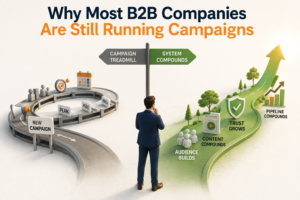
The first pressure is the quarterly reporting cycle. Boards and CEOs want to know what the marketing delivered this quarter. Campaigns easily slot into that frame. They have a date of launch, a budget, a set of metrics, and a tangible result. A system doesn’t work like that. It accumulates over quarters, so is less attributable to any one reporting period.
The second pressure is the way marketing is obtained. Most companies buy marketing as a service—campaigns, content, paid media and events. That’s what the buying model demands, so agencies are built to sell those services. Procurement sets strategy before strategy has begun.
The third one is the risk of investment.
You have to pay up front for a system before you get the full return. You can see campaign activity and results in the same period you spend money. As a CFO signing off on a budget, it feels safer. The irony is that the less risky option often results in permanent dependence on the next budget.
No one is to blame for any of this. The structure explains the behavior.
Most B2B companies are motivated to keep running campaigns because all of their measurement, procurement and investment models favor them.
Building a system requires a different leadership decision: to look beyond the quarter and invest in what makes the next quarter stronger.
What It Means to Architect Instead of Run
When I walk into a B2B marketing problem, I don’t start by asking, “What should we run this quarter? So I start by asking, what are we building this year that makes next year’s pipeline more predictable?

That shift changes every other decision we make.
A campaign manager says, “What is the budget for this campaign?” “What is the system design, and where does this campaign piece fit into that?” I ask.
A campaign manager wonders: “What did the campaign make?” I ask, “What did the system learn, and how does that learning change the architecture?
Those questions mean different priorities. They change what is built, what is measured, what is kept and what is improved.
That’s what I mean when I say I design B2B marketing systems.
I am not taking campaigns out of marketing. I’m fixing them up.
A campaign is a component.
The asset is the system.
And when the system is built correctly, every campaign makes the system smarter, not just busier for the quarter.
Campaigns End. Systems Compound.
All of this is part of the bigger case for revenue-accountable marketing. It’s about building a marketing organization where strategy, demand, pipeline, and revenue work as one system – not as disconnected quarterly activities.
My career has been about building to that model because marketing should leave an organization stronger than it found it.
Marketing & Revenue: Every Marketing Decision Is a Business Decision
Campaigns end. Systems compound. Build the thing that doesn’t stop when the budget pauses.