The Question Behind the Most Important B2B Marketing Lessons
What I learned in 20 years in B2B marketing that was most important wasn’t a technique. It was a question. And it wasn’t until I was twelve that I learned to ask it properly.
The conventional wisdom is that B2B marketing lessons are learned by mastering channels, understanding algorithms or staying ahead of whatever new platform is promising to change the industry. That’s what I thought at the beginning of my career for sure. Like many marketers, I believed execution was the key to success. Do the work good enough and the results would come.

What took me much longer to understand is that execution is seldom what separates good marketing from effective marketing.
The real division is responsibility.
In the last twenty years, the most valuable answer I received didn’t come from a framework, a campaign or a leadership position. It was born from confronting a question that lies at the heart of every meaningful B2B pipeline experience and ultimately defines what marketing teaches you when revenue is on the line.
That same question became the foundation of my B2B Marketing Thought Leadership: 20 Years of Convictions I’ve Built Along the Way, where I unpack the beliefs that two decades of building pipeline have taught me.
It was a simple question.
Did your marketing build a pipeline, or did it simply run?
Where It Started: The SEO Years
My first chapter in this career wasn’t about strategy, leadership, or revenue. It was about doing it.
Between 2005 and 2012 I worked my way up from SEO Executive to Team Lead to Senior Manager. Back in the day, my job was easy, rankings up, traffic up, visibility up. Success was when a page made it to the top of the search results. If organic traffic increased, the work was deemed effective.

I did not think that was unusual at the time. Most people I knew were working from those same assumptions. Success was evaluated with rankings, traffic and performance reports. The conversation was rarely about whether that traffic ever turned into revenue.
Looking back, the most honest thing I can say is that I didn’t know what I didn’t know.
Many of the B2B marketing lessons that seem obvious today were completely invisible to me at the time. I was learning how to do marketing, but not yet learning what marketing was ultimately responsible for.
That changed in 2013 when I joined MarketsandMarkets.
Never before in my career had I worked alongside a sales organization with pipeline targets. Suddenly, the traffic question and the revenue question were in the same room. Conversations no longer ended on performance metrics. They also moved into opportunity creation, sales results and pipeline contribution.
That exposure was the game-changer of my B2B pipeline experience. It was also the start of learning what marketing teaches you when business growth and not activity becomes the yardstick by which success is measured.
The Middle Years: When the Question Changed
I joined MarketsandMarkets in 2013 and it was a turning point in my career, but not because of the promotions that followed. The jump from Senior Manager to AVP to VP was really just a function of something much more important: with each step came a higher level of accountability.
As I progressed up the ladder, it became less about marketing activity and more about business outcomes. Campaigns, traffic and lead volume just weren’t enough anymore. Before each discussion there was a question that was getting more difficult.
One leadership meeting changed my marketing thinking for the better.
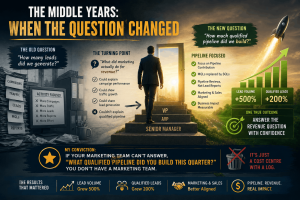
Someone asked me, “What did marketing actually do for revenue?”
I remember knowing that I couldn’t answer the question as clearly as I should have been able to.
I could explain campaign performance.
I could tell you about traffic growth.
I could explain lead generation
But I could not confidently explain the extent of qualified pipeline marketing generated.
That was not embarrassing. It was enlightening.
It exposed the difference between measuring marketing activity and understanding marketing impact.
Then everything changed.
We restructured the team to focus on pipeline contribution, not lead volume. MQLs were replaced by SQLs as the main measure of success. Marketing stopped providing sales lead reports and began providing pipeline reviews. The conversation changed from “How many leads did we generate?” to “How much qualified pipeline did we build?”
The results were in. Over the next two years, lead volume grew 500%, qualified leads grew 200%, and the marketing and sales relationship became much more aligned. Those numbers were important, but they weren’t the true outcome.
What actually happened was that marketing could, for the first time, answer the revenue question with confidence.
Those years taught me some of the most important B2B marketing lessons of my career. They changed my B2B pipeline experience and flipped what marketing teaches you when commercial accountability is the standard, not the objective.
Here I found one conviction, and it has never left me.
If your marketing team can’t answer, “What qualified pipeline did you build this quarter?” you don’t have a marketing team.
It’s just a cost centre with a logo.
The SVP Years: What Scale Teaches You
From 2019-2025 I was Vice President and then Senior Vice President running the largest demand gen operation of my career. At first glance, it was easy to think that the biggest B2B marketing lessons came from managing bigger budgets, bigger teams or more ambitious campaigns.
That’s not what scale taught me.
Scale proved what years of experience had started to whisper. The systems multiply. Campaigns do not. The demand generation engine that ended up generating over $40 million in pipeline wasn’t the result of one amazing campaign. It was the product of a system that had been built and refined and protected and allowed to compound over time.
It also confirmed that Account-Based Marketing only works when it is treated as a business decision, not simply another marketing tactic. More importantly, I realized that the gap between marketing and revenue is almost never a technology problem. It is a leadership problem. The right tools cannot fix an organization that rewards activity while expecting outcomes.

Looking back, the greatest challenge was not building the system. It was protecting it. Every quarter brought pressure to chase short-term wins, launch new campaigns, or abandon long-term thinking in favor of immediate results. The work that mattered most was resisting that pressure and allowing the system to keep compounding.
It was one of the defining chapters of my B2B pipeline experience and reinforced everything what marketing teaches you at the highest level: sustainable growth is created through discipline, not constant reinvention.
By April 2025, I knew the question was no longer if the system worked. It had passed the test. The real question was if those same principles could be rebuilt, faster, for companies confronting the same outside-in challenges.
What 20 Years in B2B Marketing Actually Teaches You
Conviction 1: Digital Marketing Should Build Pipeline. Not Reports.
The first of my B2B marketing lessons was the most difficult. I believed in better dashboards = better marketing for years. They didn’t. The turning point was when traffic, rankings and lead volume failed to provide an answer to the one question leadership really cared about: What qualified pipeline did marketing generate? When we changed what we measure, we changed what we make.
Conviction 2: Systems Beat Campaigns. Every Time.
My career’s biggest B2B pipeline experience didn’t come from one brilliant campaign. It was from a system that compounded over three years. First year looked modest. The second one looked good. The third one was awesome. “To the outside world it looked like a breakthrough. But it was really just a result of patient, disciplined execution. That’s what marketing teaches you when you build for the long term, not the next quarter.
Conviction 3: Marketing Must Be Accountable to Revenue. Full Stop.
Every promotion I received came with a higher standard of accountability. The question shifted from whether marketing was busy to whether it contributed to revenue. And that’s how I approach every engagement today. There is no report to hide behind as a senior marketing leader or even now through Fractional CMO work. And you’re either building a pipeline or you’re not. That’s the most important of all the B2B marketing lessons, and it’s the belief that runs through everything I do.
Continue Exploring These B2B Marketing Lessons
This story explains where my convictions came from.
To see how these B2B marketing lessons fit together, begin with B2B Marketing Thought Leadership: 20 Years of Convictions, which sets out the three convictions about pipeline, systems and revenue accountability.
20 yrs. Same question. Did your marketing create a pipeline or just run?