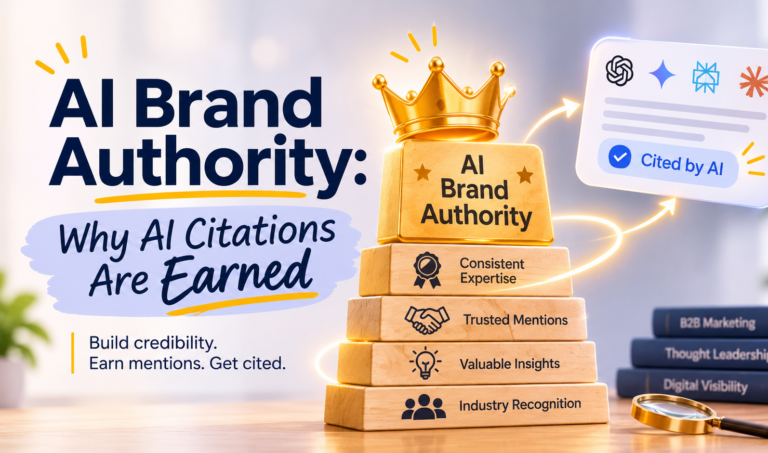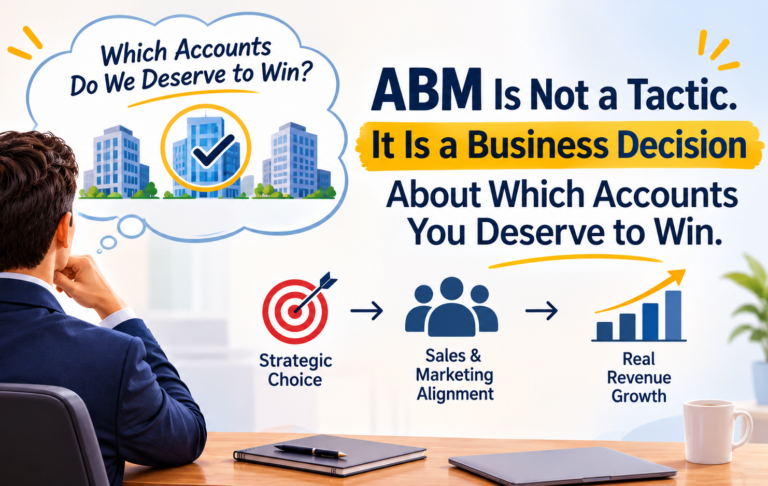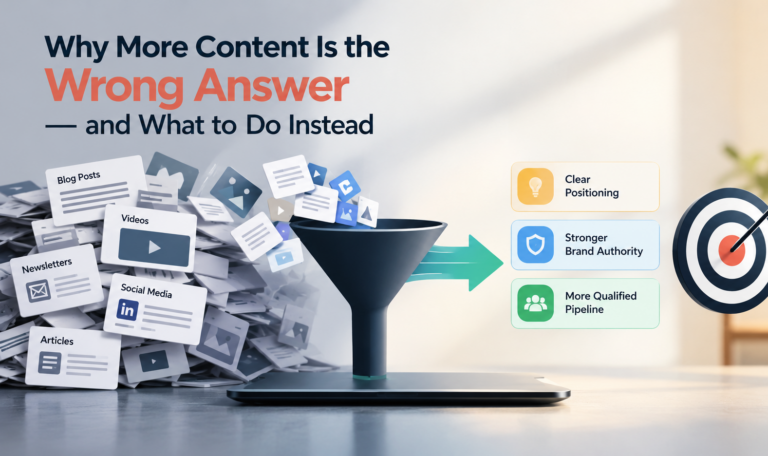
B2B Buyers are Still Looking. But increasingly, they’re not clicking. They are reading AI-generated answers that include some brands and exclude others. The brands listed above were not optimized for citation. They established the sort of authority that made citation a necessity.
That’s the change that most B2B marketing teams are not appreciating enough.
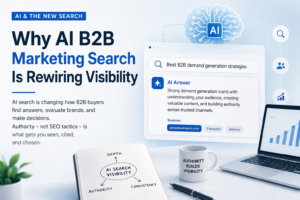
But this is not the end of search. Search is getting rewired. Discovery is shifting from a list of links to an answer based on what an AI system perceives to be credible, relevant and worth including. This new AI B2B marketing search environment changes what visibility means for B2B marketers.
To view this as another SEO update is missing the point. An exercise in optimization asks, how to capture visibility? A brand question asks an even more fundamental question: when the answer is no longer a page of rankings, do we have enough authority to be seen?
That distinction is important because AI search visibility is increasingly becoming an outcome of everything a company has built its expertise, content, reputation, consistency, and presence across the sources AI systems draw from.
Here’s my take on what this means for B2B demand generation, brand strategy, and the marketing decisions being made today that will determine who is visible in three years.
What Is Actually Changing and What Isn’t
There is a ton of noise about AI search. I find it useful to distinguish between what has changed in fact and what has not changed.
Three things are changing.
-
The format of the answer:
Artificial intelligence systems can gather information from a number of sources and return an answer to you directly. You no longer click through automatically to a particular site. For a lot of informational searches, the answer is provided before the buyer even hits a search results page.
-
The citation mechanism:
Ranking of a page is no longer the only factor for visibility. It is increasingly about whether an AI system sees a company as a reliable source of information on the subject being asked about. That takes the AI search visibility into the world of authority, not just keywords.
-
The buyer’s discovery journey.
B2B buyers are forming opinions & shortlists earlier. They can find a company, understand the expertise, and see how relevant it is before going to its website, filling out a form, or speaking to sales. If your brand isn’t in that first answer, you may never even get to the shortlist that follows.
But two things are not changing.
-
The need for genuine authority:
Signals that built authority in traditional search depth of expertise, consistency, useful content and credible external references still count. They matter more when an AI system is choosing what sources should inform an answer.
-
The primacy of the B2B buyer intent:
B2B buyers still have problems to solve and questions to answer. But they still need trusted expertise before they commit to a vendor. What has changed is the channel through which they receive that information.
That distinction is important.
The companies creating AI search visibility today are not necessarily the companies that discovered the latest AI optimization trick. They are the companies that gained enough authority to be recognized as the search experience evolved.
They weren’t planning for this moment.
They built for authority, and the time came.
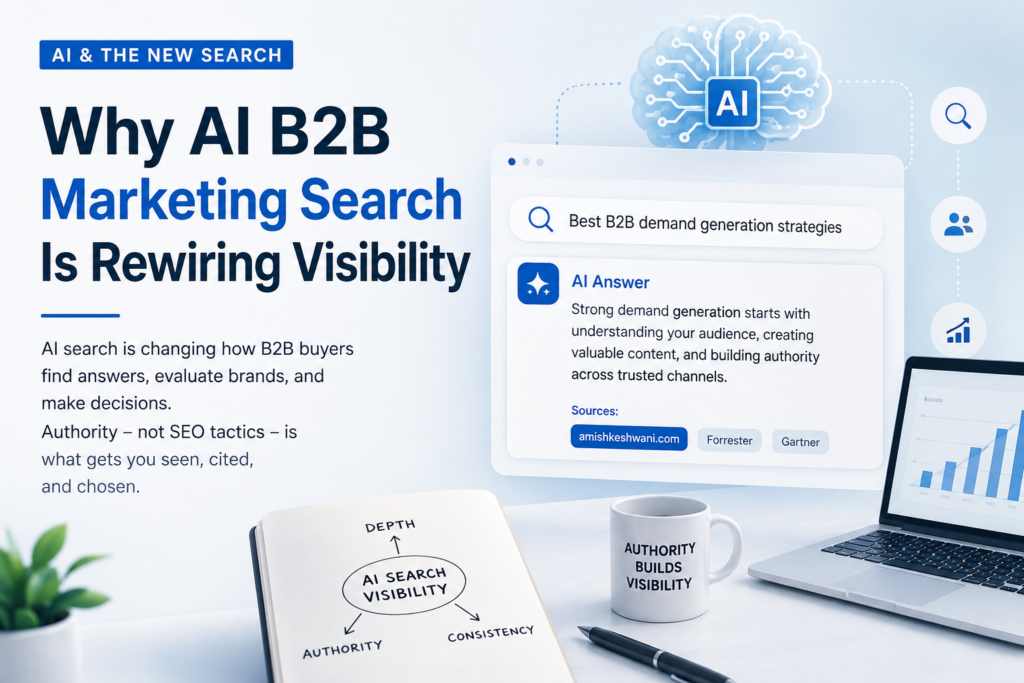
The Three Pillars of AI Search Visibility for B2B
If search visibility for AI is an authority question, then the way B2B brands build authority has to change. I’ve identified three principles that matter more than any new optimization tactic: depth, authority, and consistency.
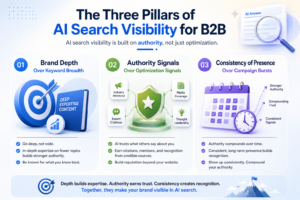
Pillar 1: Brand Depth Over Keyword Breadth
The old SEO incentivized you to go broad. The more keywords you have, the more opportunities you have to rank. This logic led to content strategies based on the coverage of as many queries as possible.
The value of the approach is changed by AI search.
The stronger signal is the depth. A brand that has established a unique and consistent perspective on an issue has a stronger claim to be considered an authority on that issue.
This is the mistake that many B2B brands make. They are distributing content over dozens of topics because the keyword universe looks attractive. The result is surface coverage without a real center of expertise.
20 well-researched, highly argued pieces on demand generation can build a much clearer authority profile for a brand than 200 thin articles spread over 40 marketing topics.
That’s why the content architecture on amishkeshwani.com is based on five categories and 45 deep posts, not hundreds of keyword-targeted articles. The objective is not to capture more search terms. To establish a recognizable body of thought.
That depth is what gets you AI search visibility.
The architecture was built for AI citation before AI citation was an objective.
Pillar 2: Authority Signals Over Optimization Signals
Artificial intelligence systems learn from the web as it is. That way they see not only what a brand says about itself but what the rest of the web says about that brand.
External references count. What the industry publications say matters. Recognition from reputable practitioners counts. Books and original thinking are important.
These are authority signals.
Meta descriptions, alt text and other on-page optimization elements are still important, but they are optimization signals. They help machines make sense of a page. They don’t, by themselves, demonstrate why the brand behind that page should be trusted.
That changes the strategic issue.
I care less about “How do we rank for this keyword?” and more about “How do we become a source that other credible sources cite when they’re talking about this topic?”
That’s more thought leadership and reputation building than traditional SEO can do.
I wrote CITED BY AI because I had developed this argument prior to AI citation becoming the dominant industry conversation. The book was not written in reaction to the shift. This was a commitment to the basic principle: authority more and more follows visibility.
The anticipation matters, because authority isn’t something a brand can manufacture overnight when a new search interface drops.
Pillar 3: Consistency of Presence Over Campaign Bursts
Authority also has a temporal dimension.
Artificial intelligence systems learn what a brand knows from the corpus of information that has been built around the brand. A recent campaign can grab attention. A viral post can generate reach. Neither is a substitute for years of consistent evidence.
A brand that has been publishing deeply and consistently on B2B demand generation for four years has built a different authority profile than a brand that published 30 posts in a six-month burst.
This is the same compounding principle that applies to demand generation.
Every useful bit is built on the body that came before it. A good reference always gives a signal. Every continuous demonstration of expertise makes it easier to associate the brand with the subject.
That’s why the brands we see most prominently in AI search in 2027 won’t necessarily be the brands that decide to “do GEO” in 2026. They are the brands creating depth, authority and consistency today.
The chance to build that advantage is already slipping away.
Brands that began three years ago have a head start. Brands can still begin building the asset today. Brands that wait to see what happens will have to buy their way across a gap that time has created.
The tactic is not the advantage.
The benefit is that you have established the authority before the answer is produced.
What This Means for B2B Marketing Strategy Right Now
The strategic response to AI search is not to add GEO to an SEO checklist. It’s about looking at what your content strategy is actually building.
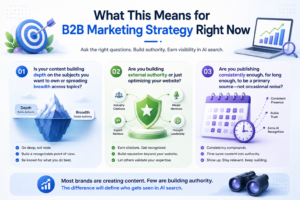
Ask yourself three questions.
Is your content building depth on the subjects you want to own or spreading breadth across the topics you want to rank for?
If your team is creating content because there is a keyword, you may be growing your footprint without building your authority. The question is not how many subjects you touch. The question is whether you have done enough thinking about the issues that matter to be known for them.
Are you building external authority or just optimizing what happens on your own website?
Industry citations, credible references, media mentions and recognition from respected practitioners tell a different story than perfectly optimized pages. One reloads the page. Another enhances the reputation of the brand behind it.
Are you publishing consistently enough and for long enough that an AI system encountering your category would recognize you as a primary source, or would it find you occasionally?
That’s the harder question because authority takes time.
The uncomfortable, honest answer for most B2B companies is this: they are producing content. They are not making authority.
That difference will become more and more apparent as AI B2B marketing search changes how buyers find and evaluate vendors.
The posts in this category work through each dimension of this argument. So let’s start with the post on what’s really happening with B2B search.
Explore the AI & New Search SeriesAI B2B marketing search
This category looks at how AI is affecting B2B search, visibility, authority and demand generation and what marketers need to do about it now.
1. Search Is Not Dying. It Is Being Rebuilt. And Most B2B Brands Are Not in the New Version.
AI is changing how buyers find information, vet brands and create shortlists. This post looks at why traditional search visibility is no longer sufficient.
2. Being Cited by AI Is Not Luck. It Is the Result of How You Build Brand Authority Over Time.
Credibility is built up, and that’s what AI citations are. This post looks at what makes certain B2B brands sources artificial intelligence systems’ trust, looking at genuine authority over short-term optimization.
3. The B2B Brands That Will Win in AI Search Are the Ones Already Doing the Right Things.
The advantage in AI search is being built before brands know they need it. In this article, we take a look at the key marketing behaviors that affect long-term AI search visibility.
4. Generative Engine Optimization Is Not a Channel. It Is a Consequence of Brand Depth.
GEO should not be treated as another marketing channel or tick box. This post argues that building genuine depth, expertise, and authority is the key to generative engine optimization B2B success.
5. Why Zero-Click Search Is Not a Threat to B2B Brands That Understand Demand Generation.
A buyer not clicking does not equal a lost opportunity. This post looks at why visibility, familiarity and influence earlier in the buying journey can be more important than the click itself.
6. AI Doesn’t Replace B2B Marketing Judgment. It Exposes Whether You Had Any to Begin With.
Artificial intelligence can accelerate execution but cannot replace bad strategic thinking. This post looks at how judgment, positioning and original thinking become more valuable as AI makes content easier to create.
7. The Signals That Make LLMs Trust and Cite Your B2B Brand and What Undermines Them.
What is it that makes one company seem credible and the other invisible? This post looks at the authority signals that LLM search B2B brands care about and what dilutes them.
8. LLM-First vs. Traditional SEO: Not a Replacement, a Hierarchy of Authority Building.
LLM-first search doesn’t make SEO moot. In this post, I discuss how traditional search and AI-based discovery are components within a broader hierarchy with authority above individual optimization techniques.
9. How I Think About AI in B2B Demand Generation Not as a Tool, but as a Force Multiplier.
Automation may not be AI’s best feature. It’s its ability to amplify great strategy content and expertise. This post shares a practitioner perspective on how AI is being applied to B2B demand generation.
Where B2B Search Goes From Here
Start with the post that frames the whole category: Search Is Not Dying. It Is Being Rebuilt. And Most B2B Brands Are Not in the New Version.
If you want to talk about what AI search means for your specific demand generation strategy, Let’s talk
AI will be citing brands in 3 years, and those brands are making content decisions today. Not a GEO decision. Content of decisions. Decisions of power.
That’s a big difference.